
Free CTET Paper 1 Mock Test
160 original questions on CDP, English, Maths and EVS, content and pedagogy. Tuned for mobile. No account needed.
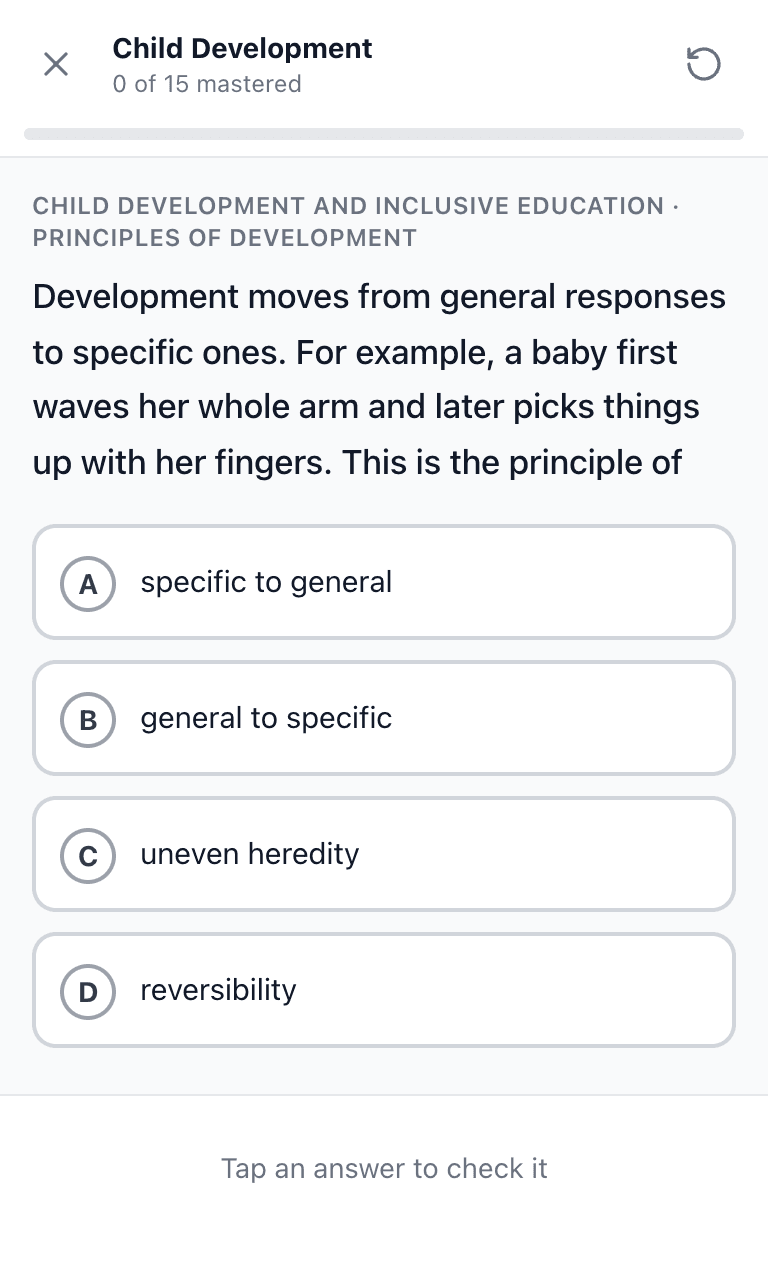
Train on mobile
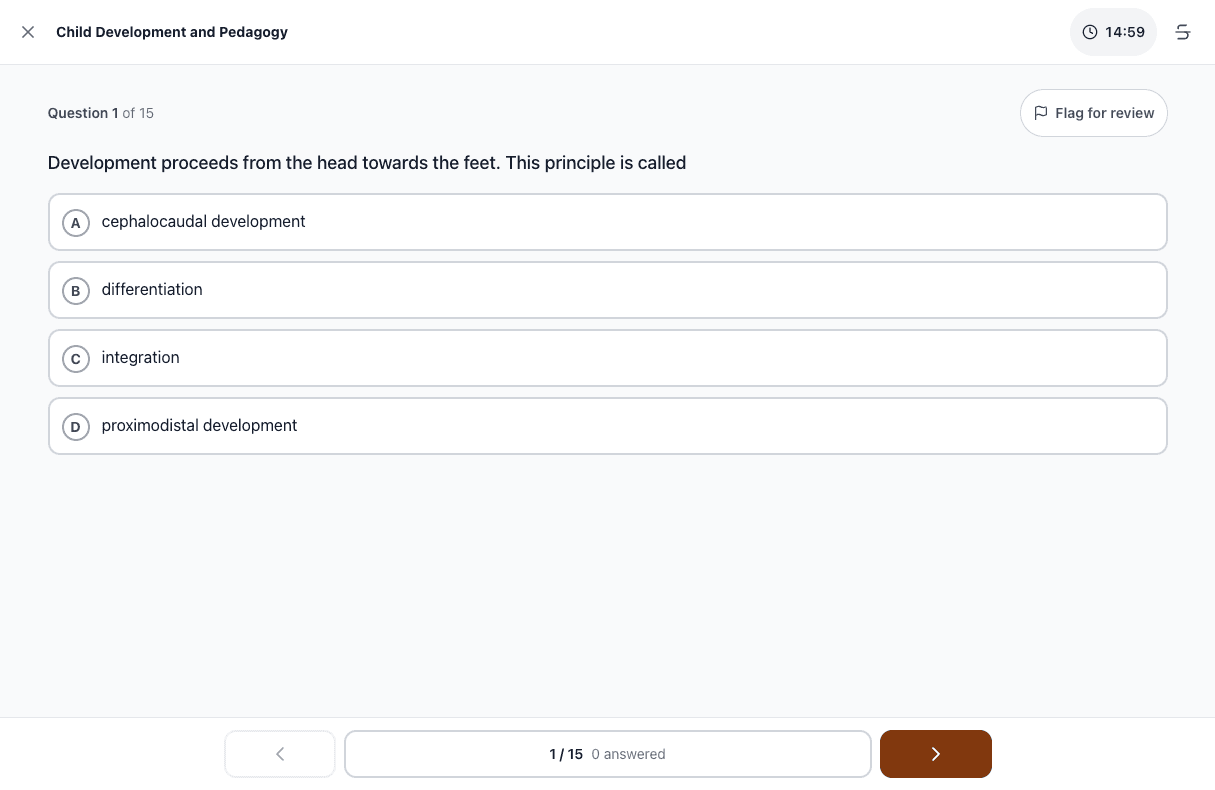
Test on desktop
The CTET exam at a glance
CTET Paper I is the Central Teacher Eligibility Test for teachers of Classes 1 to 5, conducted by CBSE. It has 150 one-mark multiple-choice questions in 2 hours 30 minutes, in five sections of 30: Child Development and Pedagogy, Language I, Language II, Mathematics and Environmental Studies, with half of each subject section on pedagogy. There is no negative marking. General candidates qualify with 60 percent (90 of 150); recruiters may give reserved categories a concession, usually to 55 percent, and the certificate is valid for life.
Tigertest has 160 CTET practice questions with explanations, all free with no account required.
- Questions
- 150 MCQs, 1 mark each
- Time
- 2 hours 30 minutes
- Sections
- CDP, Language I, Language II, Maths, EVS (30 each)
- Negative marking
- None
- Qualifying mark
- 60% (90/150); recruiters may give reserved categories a concession, usually to 55%
- Mode
- Pen and paper (OMR) in recent sessions
- Certificate
- Valid for life
- Conducted by
- CBSE, usually twice a year
Updated by the Tigertest team. Practice questions follow the CBSE CTET information bulletin and Paper I syllabus, checked October 2026. Exam rules change, so confirm current details with CBSE CTET.
How It Works
Eight Drills
Child development, learning and pedagogy, English comprehension, language pedagogy, maths, maths pedagogy, EVS and EVS pedagogy. Questions you miss come back until you have mastered them, and every answer has an explanation.
Timed Mock Tests
Two mocks of 60 questions in 60 minutes, one minute per question like the real paper: 15 each from CDP, English, Maths and EVS. Practice Test 2 is held out of the drills, so it measures readiness rather than memory.
Built on the CTET Paper I Syllabus
Paper I has five sections of 30 questions. Tigertest models four of them with the same split between content and pedagogy. Language II is not included, because you choose it from twenty languages, so prepare it separately in the language you pick.

Help Make Tigertest Better
Have an idea, a topic you'd like covered, or a question that could be clearer? We read every message and use it to improve every test.
Share FeedbackHow to Qualify CTET Paper 1
1. Take pedagogy seriously
Half of every subject section is pedagogy. The answer CTET wants is usually the child-centred one: start from what children already know, learn by doing and discussing, treat errors as clues to thinking, value home languages and assess to improve teaching rather than to rank.
2. Know the theorists and the policies
Child Development and Pedagogy leans on Piaget, Vygotsky, Kohlberg, Gardner and Bruner, inclusive education and the RPwD Act 2016, and the ideas of NCF 2005 and NEP 2020. Learn what each one says about the classroom, not just the names.
3. Read the passage before the questions
Language I opens with an unseen prose passage and an unseen poem. Read once for the main idea, then answer from the text, not from what you already believe. Expect vocabulary, grammar and figures of speech asked from the passage itself.
4. Answer every question
There is no negative marking, so never leave a bubble empty. You need 90 of 150 as a general candidate. Use the drills to find your weakest section and keep working on it until both mock tests are comfortably above 60 percent.
CTET Paper 1 Frequently Asked Questions
What is the exam pattern of CTET Paper 1?
CTET Paper I is for teachers of Classes 1 to 5. It has 150 multiple-choice questions of one mark each in 2 hours 30 minutes, in five sections of 30 questions: Child Development and Pedagogy, Language I, Language II, Mathematics and Environmental Studies. In the language, maths and EVS sections, half the questions test content and half test pedagogy. Recent sessions, including February 2026, were held on paper with OMR answer sheets.
What are the qualifying marks for CTET?
You qualify with 60 percent, which is 90 of 150 marks, as a general category candidate. Under NCTE guidelines, recruiting schools and governments may give SC, ST, OBC and disabled candidates a concession, usually to 55 percent, which is about 82 or 83 marks. There is no negative marking, so answer every question. The CTET certificate is now valid for life.
Is there negative marking in CTET?
No. A wrong answer costs nothing, so never leave a question blank. Tigertest scores the same way: every question is worth one mark and a wrong answer simply earns zero.
What does this CTET mock test cover, and what is left out?
Each mock has 60 questions in 60 minutes, the real paper's pace of one minute per question: 15 each from Child Development and Pedagogy, Language I (English), Mathematics and EVS, split between content and pedagogy like the real paper. Language II is not included, because candidates choose it from twenty languages; prepare it from your chosen language's syllabus. The questions are original and written to the CBSE syllabus, not copied from past papers.
Is the Tigertest CTET practice test free?
Yes. Both mock tests and all eight drills are free, with no account required. Create a free account if you want your progress saved across your phone and computer.
I teach a CTET or B.Ed coaching class. Can my students use Tigertest?
Yes, for free. Make a class at tigertest.io/teach, post one link, and students join with just their name. You see who practiced, their test scores and the topics your class misses most.
Related practice tests
Every test on Tigertest is free and needs no account to start.
Ready for CTET Paper 1?
Free to start. No account required. 160 questions across CDP, English, Maths and EVS.
Start practicing