
Free NSW DKT Practice Test 2026
200 questions from the Road User Handbook on L and P plate rules, demerit points, speed limits, BAC, fatigue, mobile phones, giving way, roundabouts, lanes, parking and hazards. Tuned for mobile. No account needed.
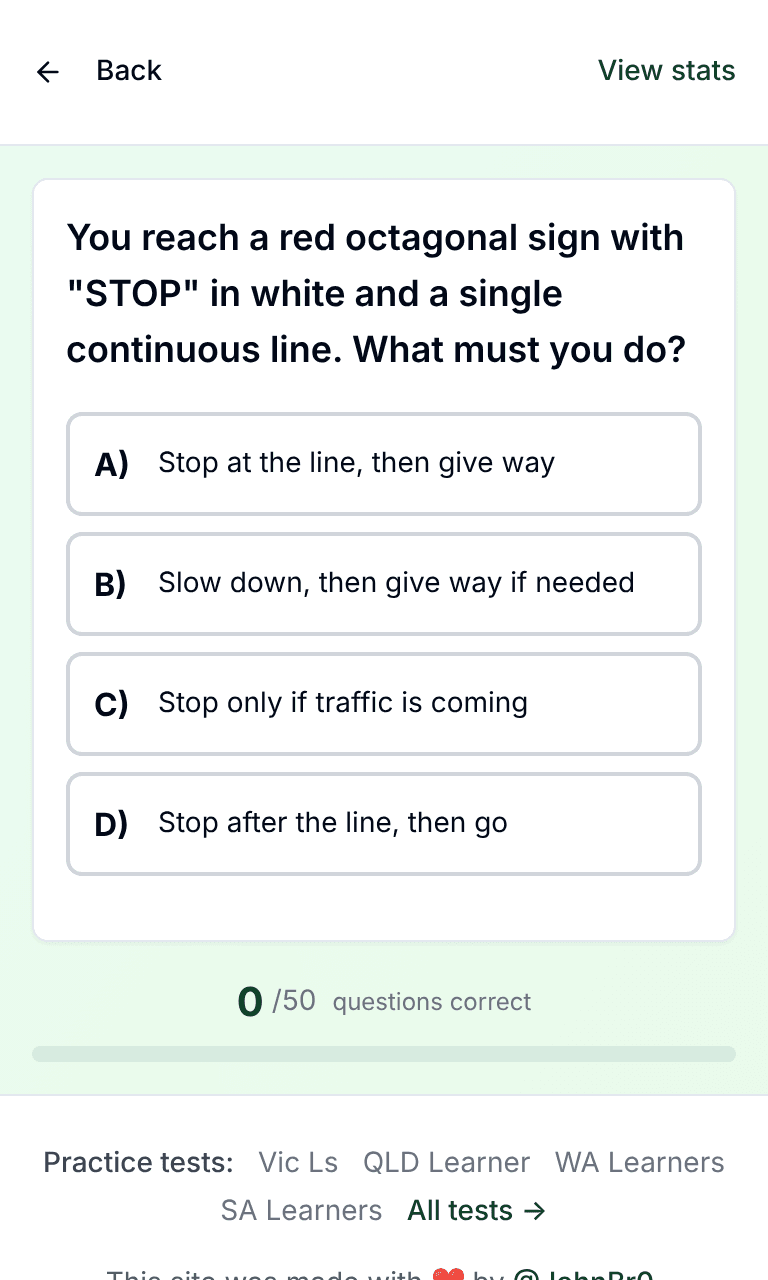
Train on mobile
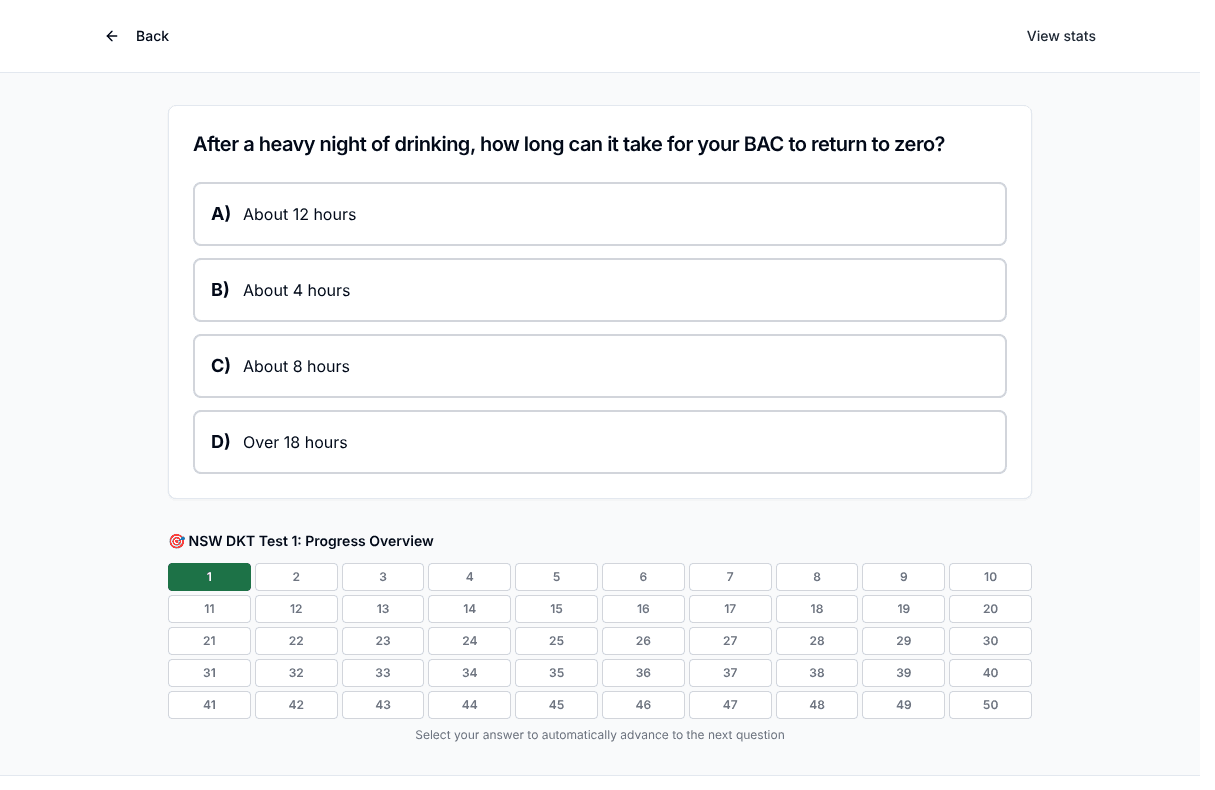
Test on desktop
The NSW DKT exam at a glance
The NSW Driver Knowledge Test (DKT) is the road rules test you pass before getting a learner licence. It is 45 multiple-choice questions in two parts: 15 general knowledge questions, of which you must get 12 right, and 30 road safety questions, of which you must get 29 right. You can take it online as part of a 4 to 6 hour course from 15 years and 11 months, or in person at a service centre from 16.
Tigertest has 200 NSW DKT practice questions with explanations, all free with no account required.
- Questions
- 45 (15 general knowledge, 30 road safety)
- Passing score
- 12 of 15 and 29 of 30 (41 of 45)
- Minimum age
- 15 years 11 months online, 16 in person
- Online retakes
- Unlimited for one fee, after 12 hours
- Languages online
- English and 8 community languages
- Given by
- Transport for NSW, through Service NSW
Updated by the Tigertest team. Practice questions follow the Transport for NSW Road User Handbook (2026 edition). Exam rules change, so confirm current details with NSW Government: Driver Knowledge Test.
How It Works
Train, Then Test
Four training sets, one per practice test: Set 1 holds exactly the 50 questions of Test 1, and so on. Master Set 1, take Test 1, then move on. Questions you miss come back until you have mastered them.
Practice Tests
Four 50-question tests covering every topic in the Road User Handbook, with a 91 percent pass line to match the real 41 of 45 and an explanation of the rule on every item.
Built on the Road User Handbook
Transport for NSW says the Road User Handbook is what prepares you for the DKT, so every question here comes from it and the practice tests cover all of its chapters. Giving way, intersections and crossings is the biggest topic, and the learner and P plate rules, BAC limits and speed limits are the numbers the test checks most, so learn those cold.

Help Make Tigertest Better
Have an idea, a topic you'd like covered, or a question that could be clearer? We read every message and use it to improve every test.
Share FeedbackHow to Pass the NSW DKT
1. Learn the numbers as a table
Zero alcohol on L and P plates and under 0.05 on a full licence. 90km/h for learners and P1, 100km/h for P2. 50km/h default in built-up areas and 100km/h elsewhere, 10km/h in a shared zone, 40km/h past a school bus with flashing lights. Demerit limits of 4 for learners and P1, 7 for P2 and 13 for a full licence. A one-page table of these is worth more than rereading the handbook.
2. Know the licence ladder
Learner licence at 16, at least 12 months and 120 logged hours with 20 at night if you are under 25, the Hazard Perception Test after 10 months, the Driving Test at 17, then a red P1 for at least a year and a green P2 for at least two. Each stage has its own passenger, phone, towing and vehicle rules, and the test asks which rule belongs to which plate.
3. Picture the give way rules
Most road safety questions describe an intersection, a roundabout or a crossing and ask who goes first. Work through them on paper: you give way to everything already in a roundabout, a right turner gives way to oncoming traffic going straight, a road ending at a T gives way to the continuing road, and turning drivers always give way to pedestrians crossing the road they enter.
4. Fix your misses, then retest
You can only miss one road safety question on the real test, so near enough is not enough. Tigertest tracks your accuracy by topic: after each practice test, retrain that test's set until every question you missed is mastered, then take all four tests back to back before you sit the DKT.
NSW DKT Frequently Asked Questions
What score do I need to pass the NSW DKT?
The DKT has two parts and you must pass both. You need at least 12 of the 15 general knowledge questions and at least 29 of the 30 road safety questions, which is 41 of 45 overall. The practice tests here use a 91 percent pass line to match, but aim to get road safety questions right every time, because two misses there fail the test.
How many questions are on the DKT and how does it work?
The test is 45 multiple-choice questions picked at random from a large question bank: 15 general knowledge and 30 road safety. You can do it online as part of the DKT online course, a 4 to 6 hour interactive course you work through at your own pace, or in person on a computer at a Service NSW centre after booking.
How old do I need to be to take the DKT?
You can enrol in the DKT online from 15 years and 11 months. The in-person test is for people aged 16 or older. Either way, you can only apply for your learner licence once you are 16, at a service centre, with your identity documents.
What happens if I fail the DKT?
Online, one test fee covers as many attempts as you need, and you can retake the test after 12 hours. In person, you may be able to re-sit the same day if there is a spot, or book another time, and you pay the test fee each time. Use the misses as your study list before the next attempt.
Does this cover the Hazard Perception Test or the driving test?
No. These questions cover the Driver Knowledge Test only, written from the Transport for NSW Road User Handbook. The Hazard Perception Test uses video clips and the Driving Test is on the road, so neither is modelled here. It is a study tool, not an official Transport for NSW test.
Related practice tests
Every test on Tigertest is free and needs no account to start.
Ready to Pass the NSW DKT?
Free to start. No account required. 200 questions across every Road User Handbook topic.
Start practicing