
Free VTNE Practice Test 2026
200 questions on animal nursing, pharmacology, surgical nursing, anesthesia, lab work, imaging, dentistry, emergency care, pain management and client communication, in the AAVSB proportions. Tuned for mobile. No account needed.
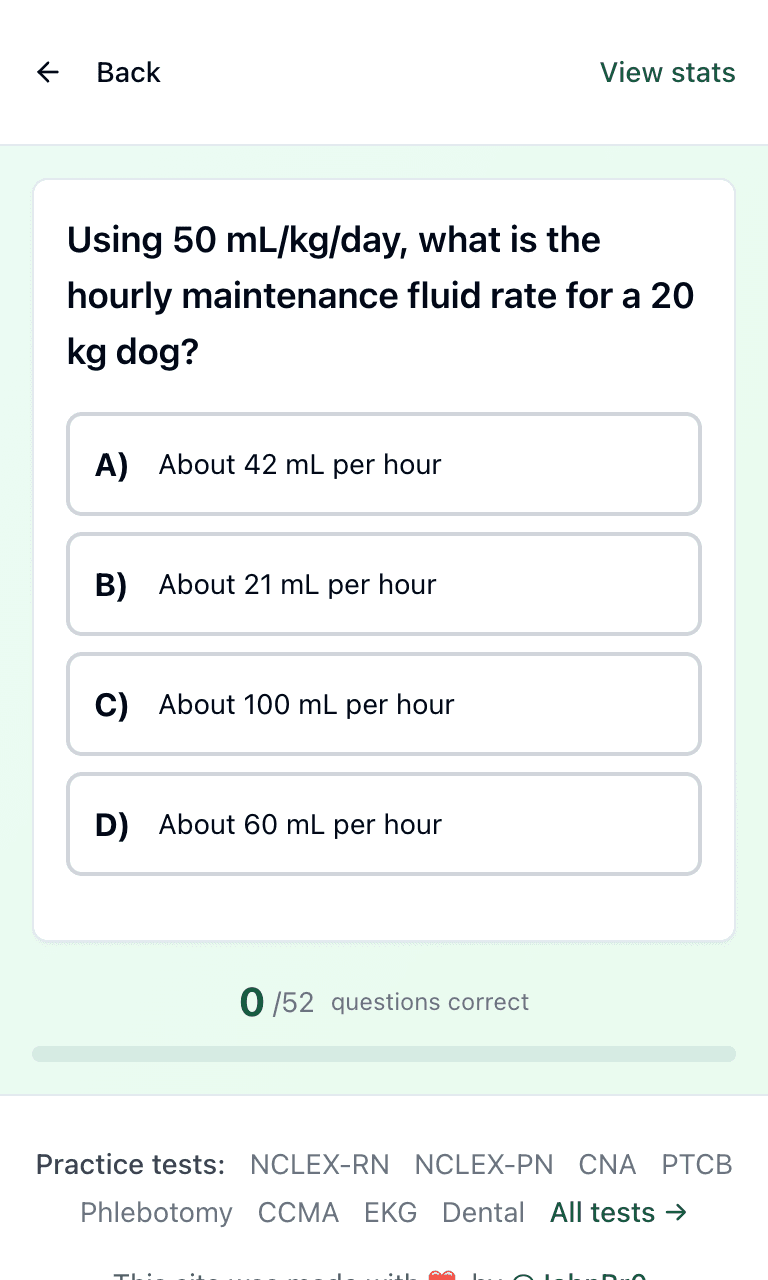
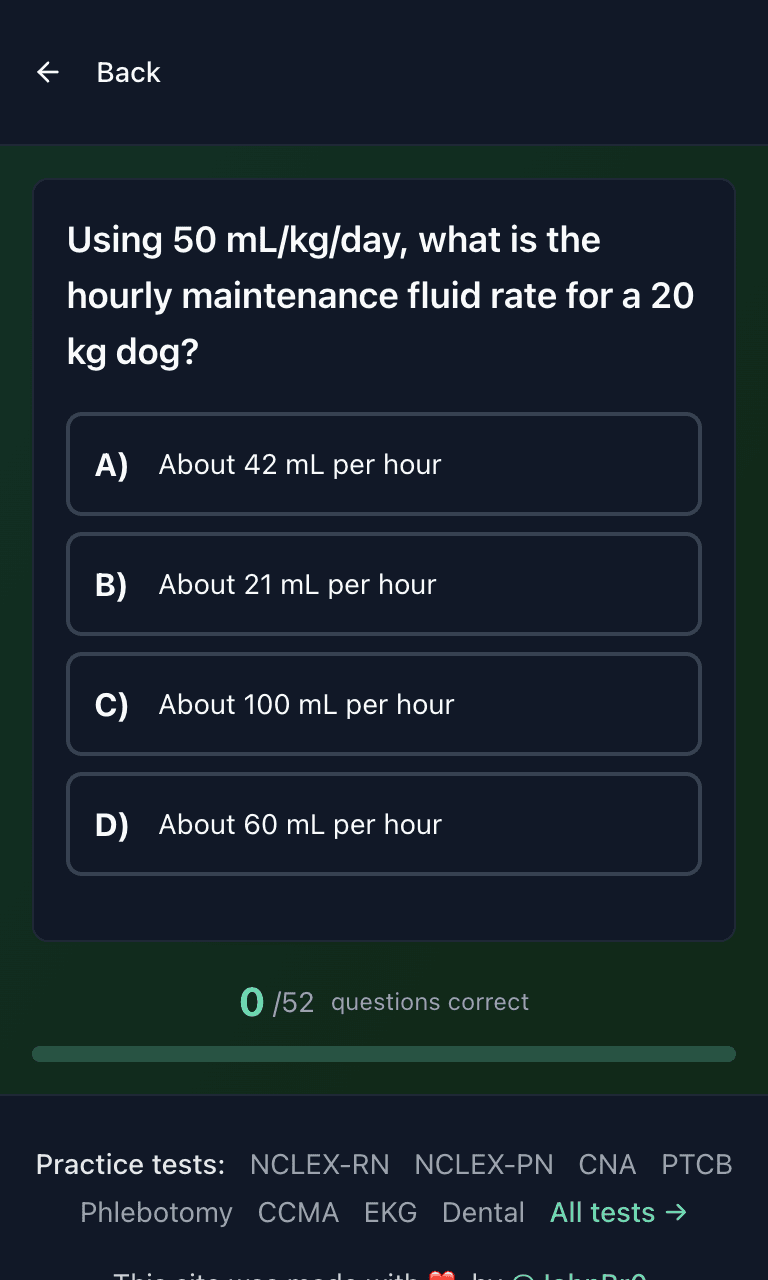
Train on mobile
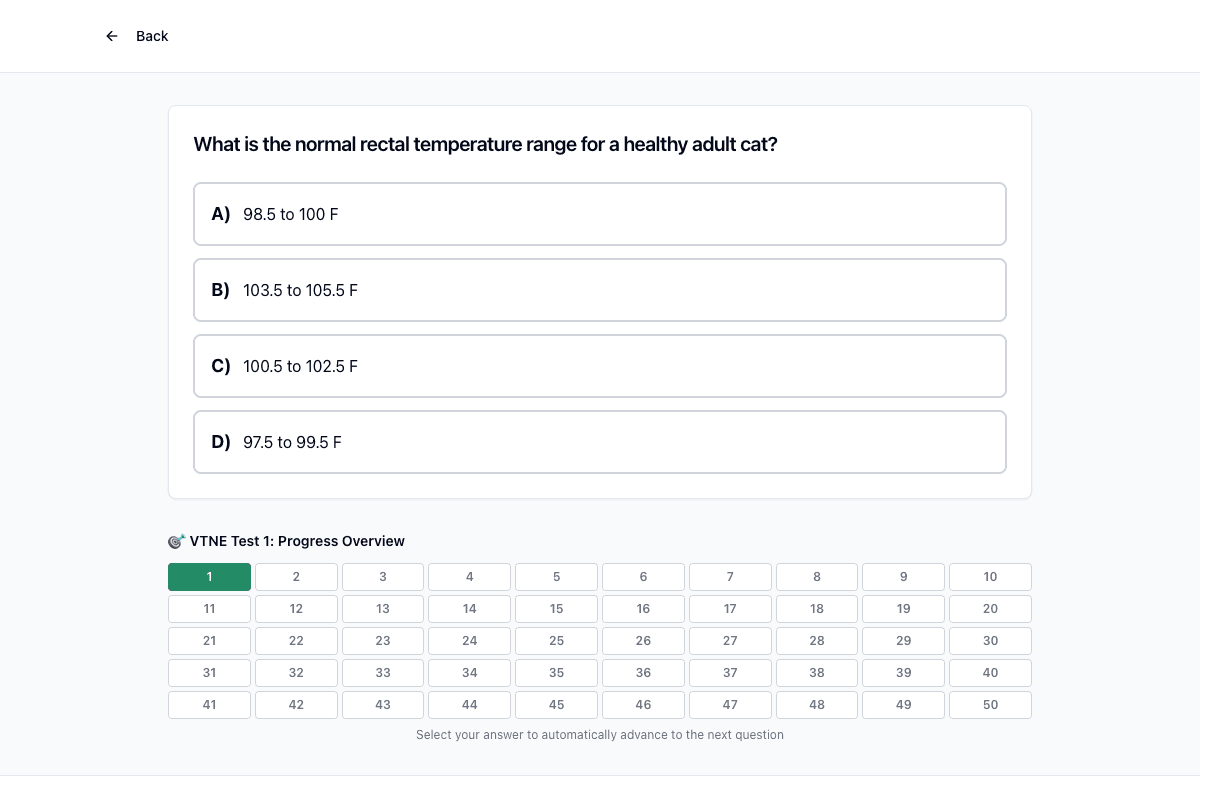
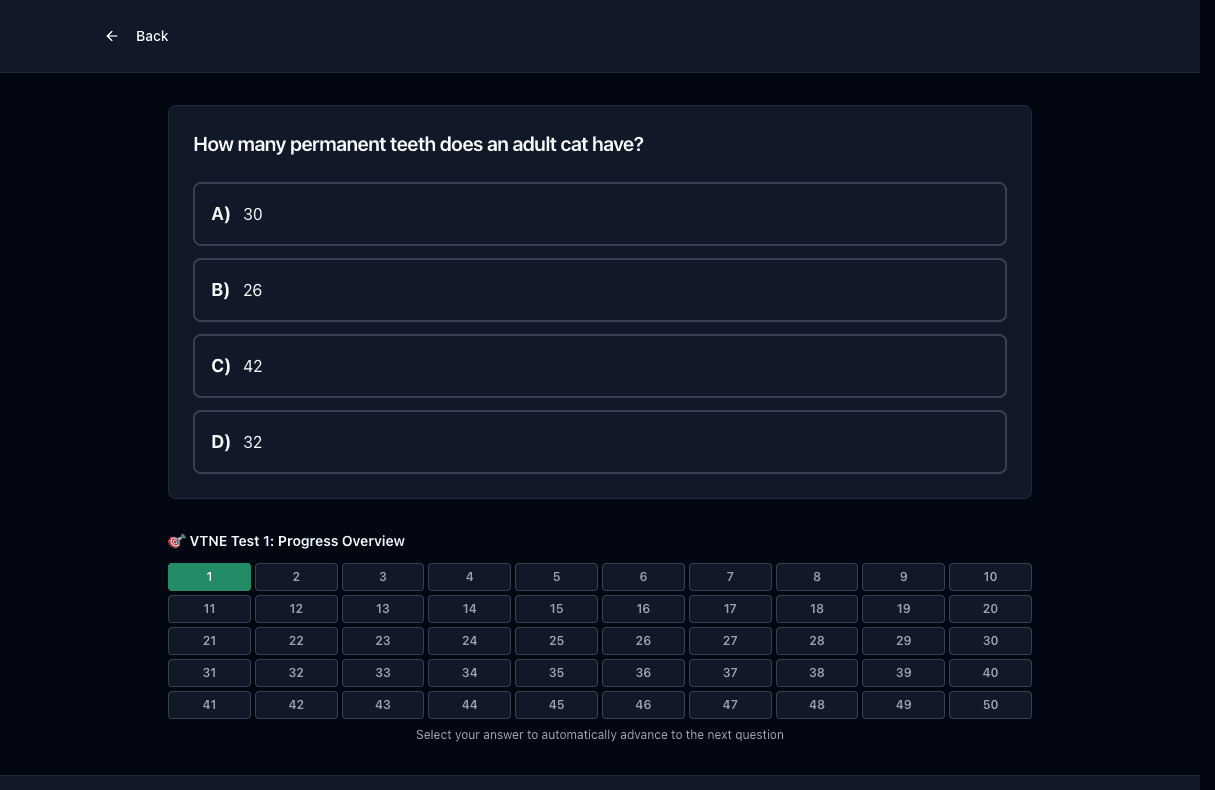
Test on desktop
The VTNE exam at a glance
The Veterinary Technician National Examination (VTNE), given by the AAVSB, has 170 multiple-choice questions, 150 scored and 20 unscored pilot items, in 3 hours at Prometric centers. It is scored on a 200 to 800 scale and 425 passes. The outline approved in March 2023 has ten domains: animal care and nursing is 20%, pharmacology, surgical nursing and anesthesia about 13% each, laboratory procedures 9%, imaging 6%, and dentistry, emergency and critical care, pain management and communication 5 to 7% each.
TigerTest has 200 VTNE practice questions with explanations, all free with no account required.
- Questions
- 170 (150 scored)
- Time
- 3 hours
- Passing score
- Scaled 425 of 800
- Fee
- $375 per attempt
- Windows
- 3 a year: Mar 15 to Apr 15, Jul 15 to Aug 15, Nov 15 to Dec 15
- Given by
- AAVSB, at Prometric test centers
Updated by the TigerTest team. Practice questions follow the AAVSB VTNE content outline approved March 2023. Exam rules change, so confirm current details with AAVSB VTNE Candidate Information Handbook.
How It Works
Training by Domain
Four sets: animal care and communication, pharmacology and lab procedures, anesthesia with pain management and emergency care, and surgery with dentistry and imaging. Questions you miss come back until you have mastered them.
Practice Tests
Four 50-question tests weighted the way the VTNE is, with a 70 percent practice pass line and an explanation of the right answer and the common wrong pick on every item.
Built on the AAVSB Content Outline
The AAVSB publishes exactly how the 150 scored VTNE items are split across ten domains, and the practice tests here follow that split. Animal care and nursing is the biggest single domain, and pharmacology, surgical nursing and anesthesia together are another 40 percent, so those four sets are where most of your study time should go. Vet tech programs accredited by the AVMA CVTEA can assign TigerTest as a class at tigertest.io/teach and see which domains the cohort misses most.

Help Make TigerTest Better
Have an idea, a topic you'd like covered, or a question that could be clearer? We read every message and use it to improve every test.
Share FeedbackHow to Pass the VTNE
1. Own the calculations
Dose and fluid math shows up in several domains, and every item is the same three steps: weight in kilograms, milligrams from the mg/kg dose, milliliters from the concentration. Maintenance fluids run 40 to 60 mL/kg/day, a deficit is body weight times percent dehydration, and a drip rate is volume over time times the drops per mL of the set. Practice until you can do them without the calculator.
2. Learn the species differences as a table
Normal temperature, heart rate and respiratory rate for dogs, cats, horses, cattle and the common lab and exotic species; which drugs are dangerous in which species (xylitol, lilies and acetaminophen in cats, ivermectin in some herding breeds); and the blood types that matter for a first transfusion. Exam questions give you the patient and expect the number.
3. Study anesthesia and surgery as one patient timeline
ASA status and pre-anesthetic bloodwork, then premedication, induction, intubation, circuit and bag choice, oxygen flow, monitoring (capnography, SpO2, blood pressure, depth signs), then recovery and hypothermia. Surgical nursing runs alongside it: pack prep and sterilization indicators, patient prep, instrument handling, suture choice and post-op monitoring. Walking one patient through the whole day keeps the facts in order.
4. Drill your weak domain to 85 percent
TigerTest tracks your accuracy by domain. The VTNE passes on a scaled score, so there is no magic percentage, but students who clear 85 percent in every training set and 70 percent on all four practice tests have covered the outline. Retake the set you miss most, then take the four tests back to back the week before your window.
VTNE Frequently Asked Questions
What score do I need to pass the VTNE?
The VTNE reports a scaled score from 200 to 800, and 425 passes. The AAVSB does not publish a percent-correct equivalent, so the practice tests here use a 70 percent pass line as a study target. Clearing it with room to spare on all four tests is a good sign you are ready.
How many questions are on the VTNE and how long do I get?
The VTNE has 170 multiple-choice questions, 150 of which are scored; the other 20 are unscored pilot items you cannot tell apart from the rest. You have three hours. The exam is given by computer at Prometric test centers during three windows a year: March 15 to April 15, July 15 to August 15 and November 15 to December 15.
What is on the VTNE?
Ten domains from the AAVSB content outline approved in March 2023: animal care and nursing (20 percent), pharmacy and pharmacology, surgical nursing and anesthesia (about 13 percent each), laboratory procedures (9 percent), diagnostic imaging (6 percent), and dentistry, emergency medicine and critical care, pain management and analgesia, and communication and professional support services at 5 to 7 percent each. The practice tests here use the same proportions.
Who can take the VTNE and what does it cost?
Most candidates are graduates of a veterinary technology program accredited by the AVMA Committee on Veterinary Technician Education and Activities (CVTEA). Some states and provinces have alternate pathways; check your board. The AAVSB application fee is 375 dollars per attempt, and you must test in the window you applied for or forfeit it. Retakes need a new application, and the AAVSB allows up to five attempts.
Does this practice test cover state rules or a specific textbook?
No. The VTNE is a national exam, so every question here is about universal veterinary nursing practice: species vital signs, drug calculations, aseptic technique, anesthesia monitoring, lab and imaging procedures, dental charting and emergency care. Which tasks a credentialed technician may perform varies by state and is left to your state board. It is a study tool, not a credential.
I teach a veterinary technology program. Can my students use TigerTest?
Yes, for free. Make a class at tigertest.io/teach, post one link, and students join with just their name. You see who practiced, their test scores and the topics your class misses most.
Related practice tests
Every test on TigerTest is free and needs no account to start.
Ready to Pass the VTNE?
Free to start. No account required. 200 questions across all ten content domains.
Start practicing