
Free Working at Heights Practice Test 2026
200 questions for the knowledge assessment in RIIWHS204 Work safely at heights: the falls hierarchy, ladders, scaffolds and EWPs, harnesses and anchors, roof work and rescue. Tuned for mobile. No account needed.
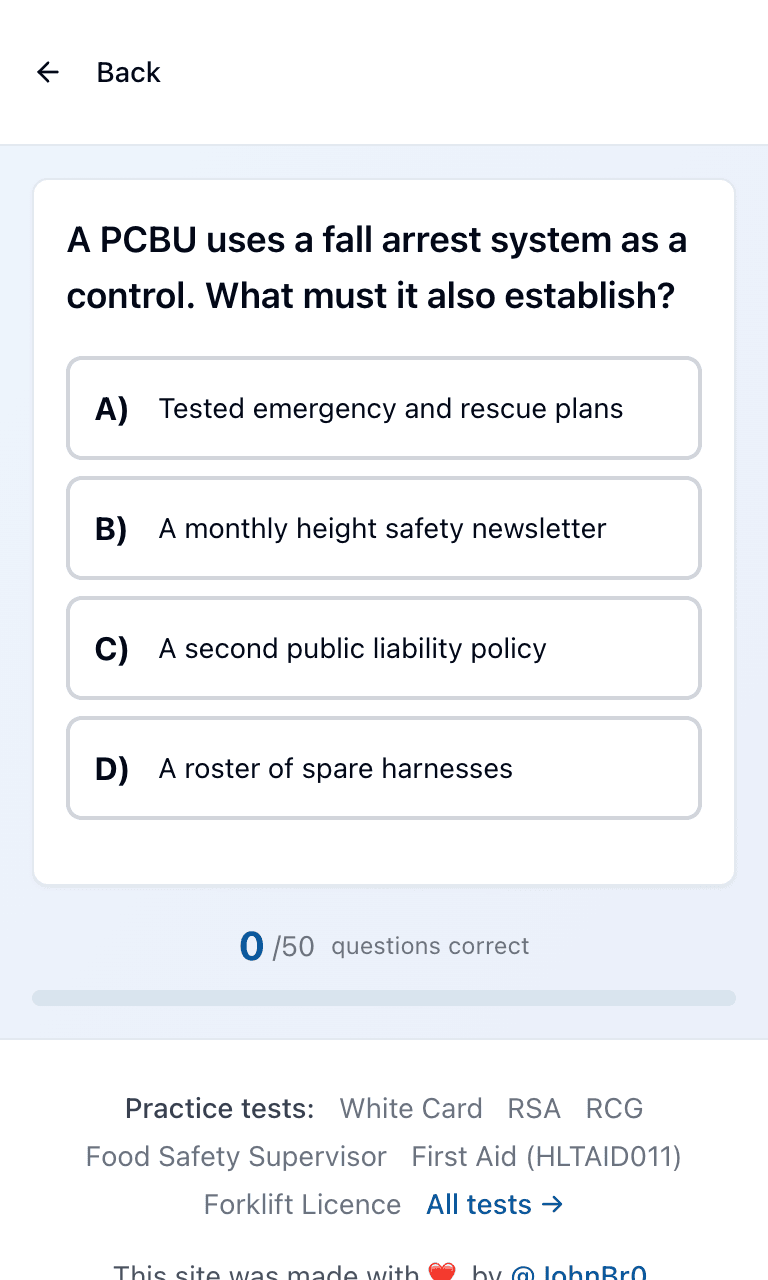
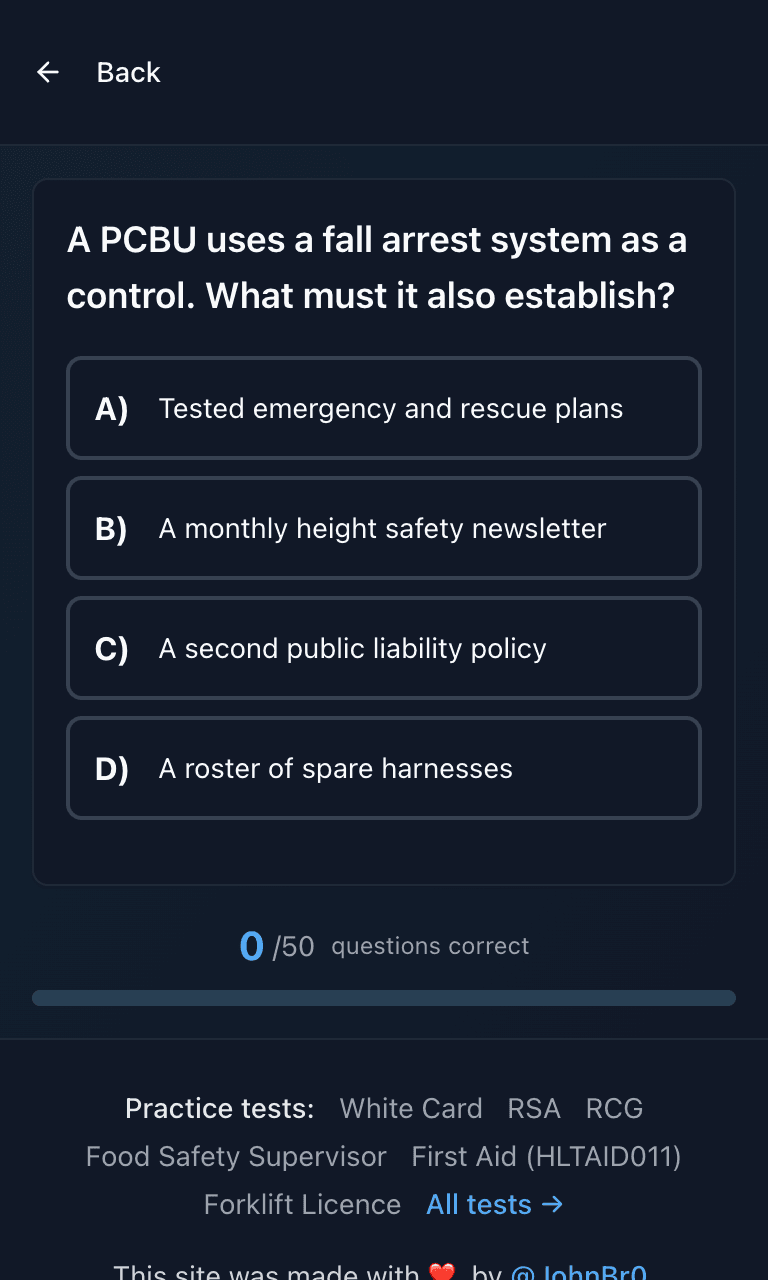
Train on mobile
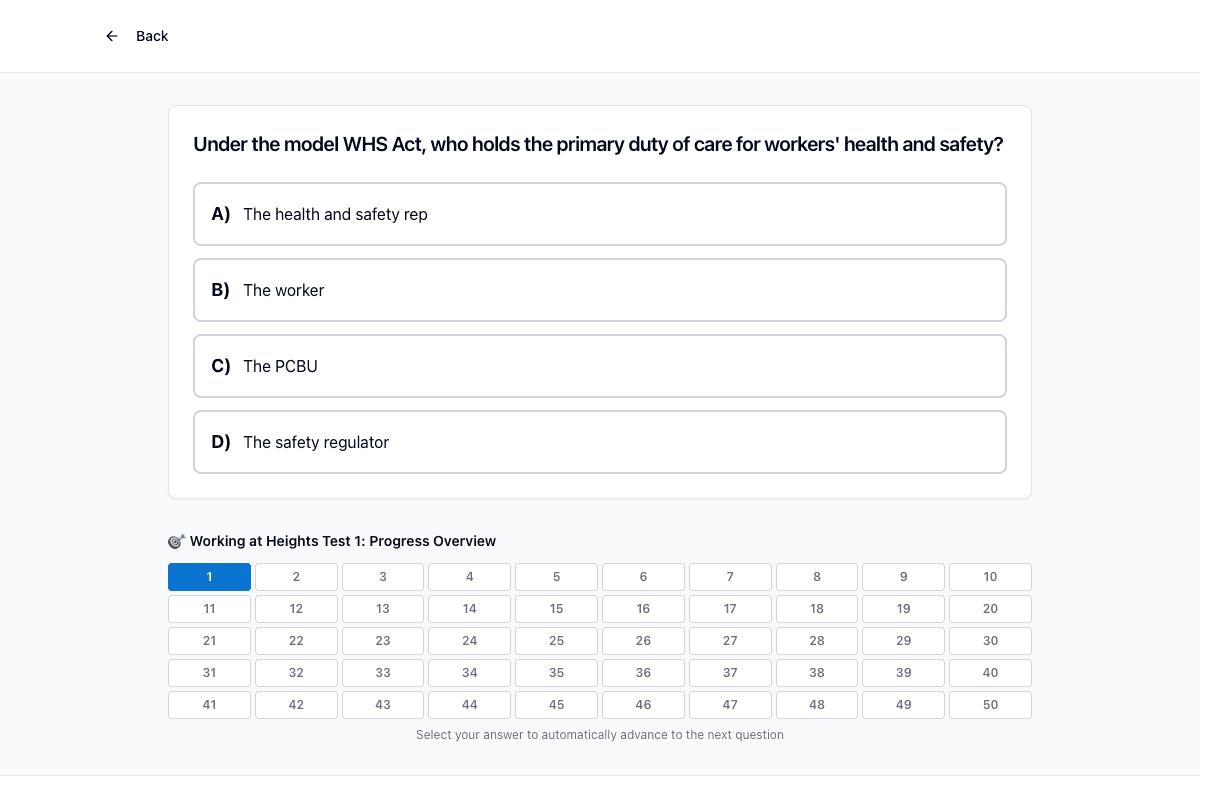
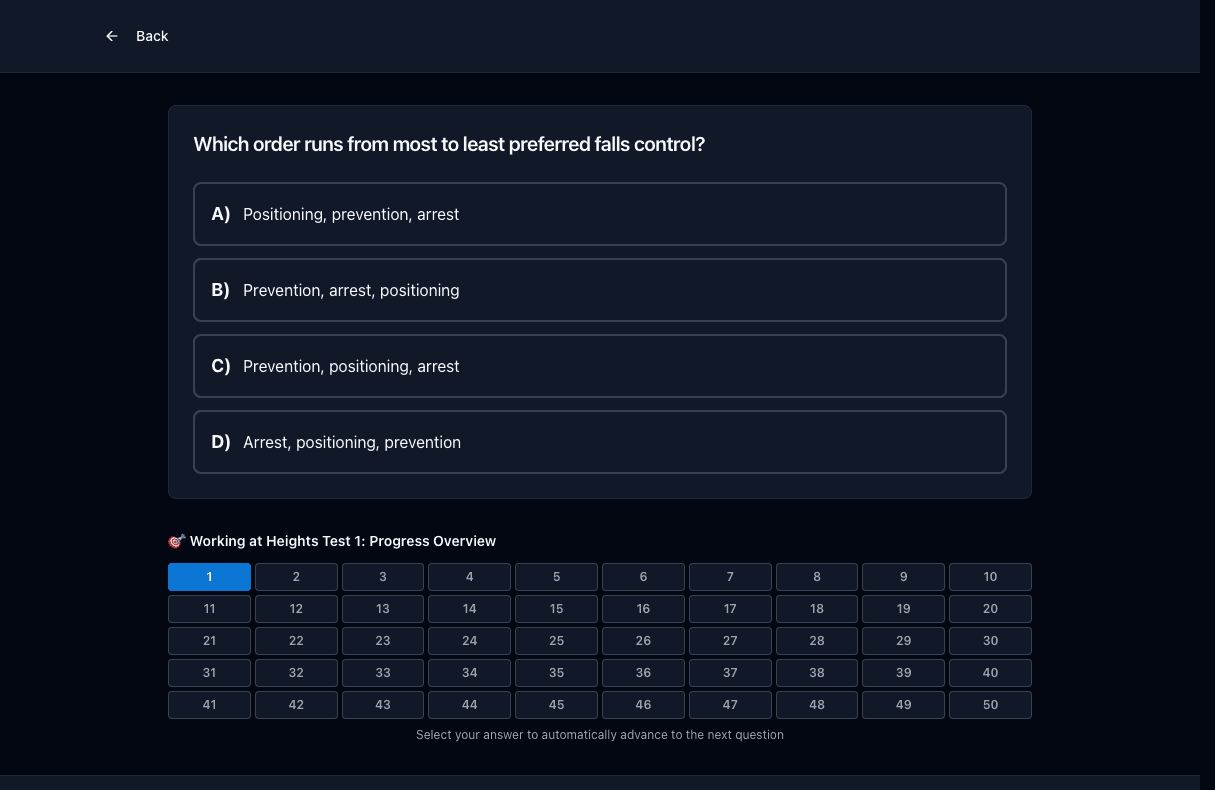
Test on desktop
The Working at Heights exam at a glance
Working at heights training in Australia is the nationally recognised unit RIIWHS204 Work safely at heights, which replaced RIIWHS204E in September 2026 as an equivalent unit. It is usually a one-day course with a registered training organisation, assessed by practical tasks plus a written knowledge assessment that each RTO sets, with no national pass mark. The unit has no expiry date, though some employers set their own refresher requirements, and site rules vary by state and territory.
Tigertest has 200 Working at Heights practice questions with explanations, all free with no account required.
- Unit
- RIIWHS204 (formerly RIIWHS204E)
- Course length
- Usually 1 day
- Assessment
- Practical tasks plus a knowledge test
- Pass mark
- Set by each RTO (competency based)
- Delivered by
- Registered training organisations
- Expiry
- None set; some employers require refreshers
- Rules
- Model WHS Regulations and falls codes
- State differences
- Vary by state and territory
Updated by the Tigertest team. Practice questions follow the RIIWHS204 unit, the model WHS Regulations and the Safe Work Australia falls codes of practice. Exam rules change, so confirm current details with training.gov.au: RIIWHS204 Work safely at heights.
How It Works
Train, Then Test
Four training sets, one per practice test: Set 1 holds exactly the 50 questions of Test 1, and so on. Master Set 1, take Test 1, then move on. Questions you miss come back until you have mastered them.
Practice Tests
Four 50-question practice tests covering every part of the unit, with an 80 percent readiness line (each RTO sets its own pass mark) and an explanation of the right answer on every question.
Built on RIIWHS204 and the Falls Codes
RIIWHS204 sets what a working at heights course must cover: work requirements and documents, hazards and controls, fall protection equipment, doing the work, and cleaning up. The detail comes from the model WHS Regulations and the Safe Work Australia codes of practice on falls. No one publishes how many questions each topic gets, so the practice tests weight topics by how much of the course they fill. Trainers and RTOs can set Tigertest as practice for a class at tigertest.io/teach and see which topics the group misses most.

Help Make Tigertest Better
Have an idea, a topic you'd like covered, or a question that could be clearer? We read every message and use it to improve every test.
Share FeedbackHow to Pass Working at Heights
1. Know the falls hierarchy in order
Work on the ground or a solid construction first. If you cannot, use a fall prevention device such as guardrails, a scaffold or an EWP, then a work positioning system such as restraint, then a fall arrest system. Administrative controls like permits and no go areas only support the others.
2. Lock in the numbers
A SWMS for construction work with a fall of more than 2 metres. Guardrails 900 to 1100 mm high with a mid-rail and toe-board. Ladders at 4 up to 1 out, rated to at least 120 kg and extending 1 metre above the landing. A free fall of no more than 2 metres, and a single-person anchor commonly rated to 15 kN.
3. Check gear and plan the rescue
Inspect every harness, lanyard and connector before use and take anything frayed, cut or past its date out of service. Gear that has arrested a fall stays out of use until a competent person checks it. Never work alone in a harness: suspension intolerance can set in within minutes, so the rescue plan must be tested before work starts.
4. Fix your misses, then retest
Tigertest tracks your accuracy by topic. Aim for 40 or more out of 50 on all four practice tests before your course. After each test, drill the questions you missed and retrain that test's set. Then practise fitting a harness and setting up a ladder with your trainer.
Working at Heights Frequently Asked Questions
What is the working at heights course in Australia?
It is the nationally recognised unit RIIWHS204 Work safely at heights, which replaced RIIWHS204E in September 2026 as an equivalent unit, so a RIIWHS204E statement of attainment still counts. It is usually a one-day course with a registered training organisation (RTO) and covers WHS duties, finding fall hazards, the hierarchy of control for falls, ladders, scaffolds and EWPs, harnesses and anchors, and emergency and rescue procedures.
How is the course assessed, and what is the pass mark?
You show the trainer you can work safely at heights in practical tasks, such as checking and fitting a harness, choosing an anchor and setting up a ladder, and you complete a written or online knowledge assessment. The unit is competency based, so there is no national question count or pass mark: each RTO sets its own marking, and often lets you resubmit answers that are not yet satisfactory. The practice tests here have 50 questions each and use an 80 percent readiness line.
Which rules do these questions follow?
The answers follow the model Work Health and Safety Regulations on falls and the Safe Work Australia model Codes of Practice on managing the risk of falls at workplaces and in housing construction: work on the ground or a solid construction first, then fall prevention devices, then work positioning, then fall arrest. Figures such as a 900 to 1100 mm guardrail, a 4 to 1 ladder slope and a 2 metre maximum free fall come from those codes. Where rules differ by state or territory, the questions say so instead of picking one.
Does a working at heights certificate expire?
The unit itself has no expiry date. Some employers and principal contractors set their own refresher requirements, so check what your site asks for; site and industry rules also vary by state and territory. A working at heights unit is not a high risk work licence: erecting a scaffold from which a person or object could fall more than 4 metres, or operating a boom-type EWP with a boom of 11 metres or more, needs the matching licence.
Is this an official assessment or certificate?
No. Every question is written by Tigertest from the RIIWHS204 unit, the model WHS Regulations and the Safe Work Australia codes of practice, so it tests the same knowledge without copying any training organisation's assessment. It is free study for the knowledge part of the course, not a statement of attainment, and it cannot replace the hands-on practice and assessment that an RTO provides.
I teach working at heights courses. Can my students use Tigertest?
Yes, for free. Make a class at tigertest.io/teach, post one link, and students join with just their name. You see who practiced, their test scores and the topics your class misses most.
Related practice tests
Every test on Tigertest is free and needs no account to start.
- White Card Practice TestCPCWHS1001 · general construction induction (RTO course)
- RSA Practice TestSITHFAB021 · national RSA unit, Australia
- RCG Practice TestSITHGAM022 · RCG / RSG, all states
- Food Safety Supervisor Practice TestSITXFSA005 + SITXFSA006 · FSANZ Standard 3.2.2A
- HLTAID011 Provide First Aid Practice TestHLTAID011 · Australian Resuscitation Council guidelines
- Forklift Licence Practice Test (Australia)TLILIC0003 · high risk work licence LF, Australia
Ready to Pass Working at Heights?
Free to start. No account required. 200 questions across every part of the RIIWHS204 working at heights unit.
Start practicing