
Free Belgium Driving Theory Test Practice 2026
200 original questions in English on the Belgian Highway Code: priority to the right, signs, markings, regional speed limits, overtaking, motorways and parking. Four 50-question mock tests at the real 41/50 pass mark. Tuned for mobile. No account needed.
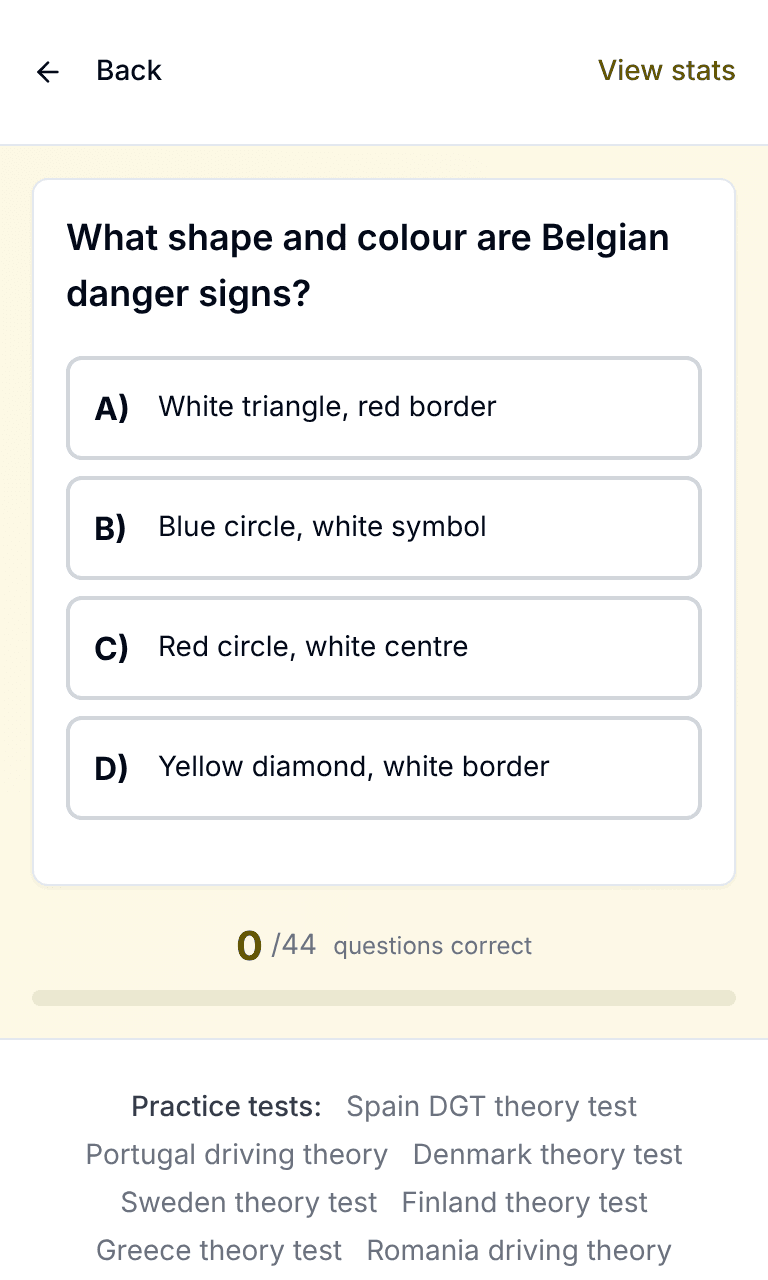
Train on mobile
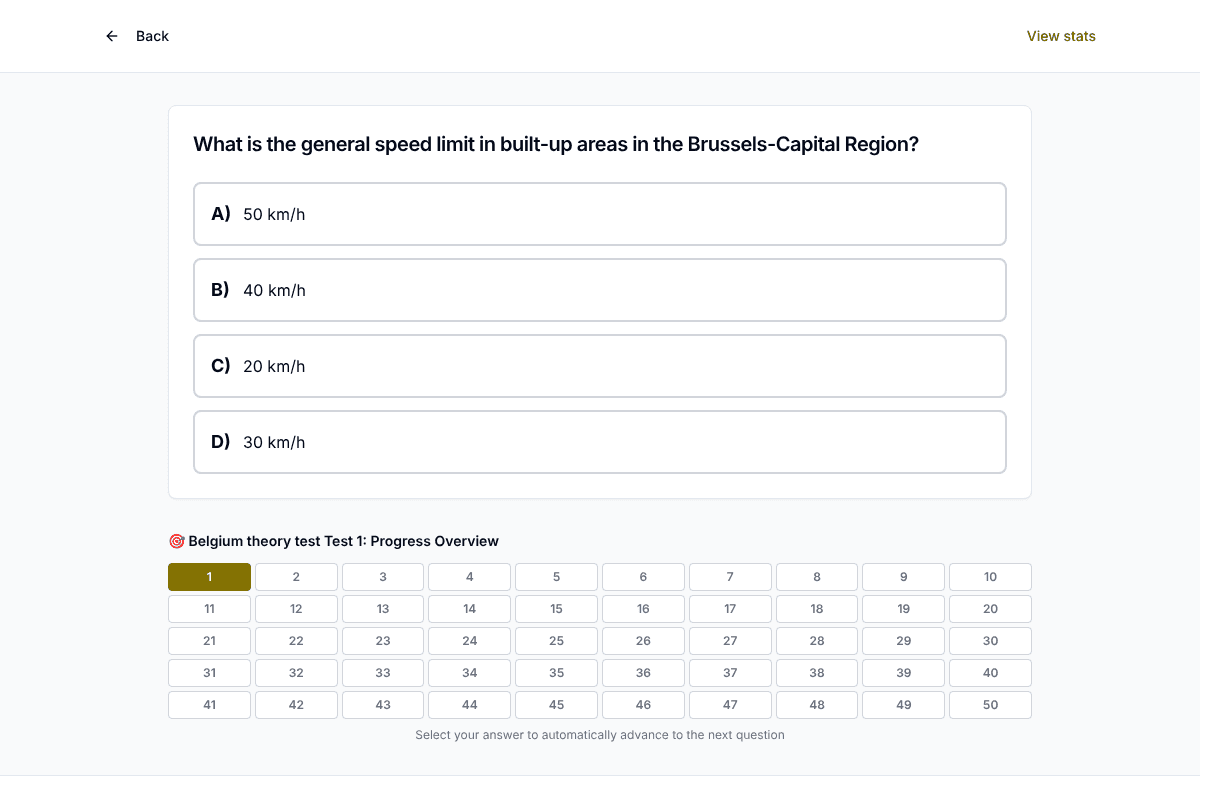
Test on desktop
The Belgium theory test exam at a glance
The Belgian theory exam for a category B (car) licence is taken at an approved exam centre in Flanders, Wallonia or Brussels. It has 50 multiple-choice questions on a screen. You start with 50 points and need at least 41 to pass: a wrong or unanswered question costs 1 point, and a wrong answer on a serious-fault question (a third- or fourth-degree offence or a speed limit) costs 5. You must be at least 17, and a pass is valid for three years. In Flanders the exam is in Dutch with an optional English audio translation; in Wallonia it is in French, with English by appointment at two centres; in Brussels it is in French or Dutch with an interpreter for English. After two consecutive failures you must take 12 hours of theory lessons at a driving school (Flanders and Brussels; guides say the same for Wallonia).
Tigertest has 200 Belgium theory test practice questions with explanations, all free with no account required.
- Run by
- Approved exam centres in Flanders, Wallonia and Brussels
- Questions
- 50 multiple choice
- Pass mark
- 41 of 50 points
- Serious fault
- Costs 5 points (third/fourth-degree offences and speed limits)
- Time
- Up to 15 seconds per question (Flanders, Brussels); about 30 minutes in Brussels
- In English
- Audio translation (Flanders), by appointment (Wallonia), interpreter (Brussels)
- Minimum age
- 17
- Pass valid for
- 3 years
- Tigertest mock tests
- 4 x 50 questions, 41 to pass
Updated by the Tigertest team. Practice questions follow Vlaanderen.be and Wallonie.be theory exam pages, the Brussels Mobility exam page (be.brussels), and the Belgian Highway Code (Royal Decree of 1 December 1975), checked November 2026. Exam rules change, so confirm current details with Vlaanderen.be: theory exam for licence B.
How It Works
Train by Topic
Five training sets cover road signs, priority and markings, speed and overtaking, vulnerable road users and parking, and the exam, lights and safety. Questions you miss come back until you have mastered them.
Full Mock Tests
Four 50-question tests that together cover all 200 questions, scored at 41 out of 50 like the real exam. Tigertest counts every mistake as one point; the real exam takes five for a serious fault, so aim higher.
Built on the Belgian Highway Code
Every question comes from the federal Highway Code that the exams in Flanders, Wallonia and Brussels all test: priority to the right, trams first, the zip merge, the emergency corridor, the 30, 20 and walking-pace zones, and the parking distances. Where the regions differ, as they do on speed limits, the question names the region. No region publishes a topic split, so these weights are Tigertest's own, with priority and signs heaviest. Signs are described in words, and the risk perception videos are not modelled.

Help Make Tigertest Better
Have an idea, a topic you'd like covered, or a question that could be clearer? We read every message and use it to improve every test.
Share FeedbackHow to Pass the Belgian Theory Exam
1. Master priority to the right
Belgium gives way to the right at any junction without signs, and many drivers from abroad get this wrong. Learn the exceptions: trams always go first, a yellow diamond gives you priority, a downward triangle or STOP takes it away, and a driver already on a roundabout or coming out of a no-entry street does not get it.
2. Learn the limits for your region
Speed questions are serious faults worth five points. Know the defaults (30 in Brussels towns, 50 in Flemish and Walloon towns, 70 outside towns in Flanders and Brussels, 90 in Wallonia, 120 on motorways) and the zones: 30 zones, 20 in residential zones, walking pace in pedestrian zones and school streets.
3. Book the language you need
If you want English, ask your exam centre when you book: an audio translation in Flanders, an appointment at Couillet or Wandre in Wallonia, or an interpreter in Brussels. Each one costs extra and some need notice.
4. Aim well above 41
Two serious faults sink you even if everything else is right, so aim for 46 or more in every mock test. Tigertest tracks your accuracy by topic: drill the questions you missed, retrain the weakest set, then take all four tests back to back before exam day.
Belgium Driving Theory Test Frequently Asked Questions
What is the Belgian theory exam like?
The category B theory exam has 50 multiple-choice questions on a screen at an approved exam centre in Flanders, Wallonia or Brussels. You start with 50 points and need at least 41 to pass. A wrong or unanswered question costs 1 point, but a wrong answer on a serious-fault question (a third- or fourth-degree offence, or a speed limit) costs 5 points, so two serious faults alone mean a fail. In Flanders and Brussels you get up to 15 seconds per question (in Flanders the 15 seconds start once the question has been read aloud), and Brussels says the exam takes about 30 minutes. You must be at least 17, and a pass is valid for three years.
Can I take the Belgian theory exam in English?
Yes, with some conditions. In Flanders the exam is in Dutch, and since 1 January 2023 you can add an audio translation into English, French or German: you hear each question in Dutch, then in English. In Wallonia the exam is in French, with German at Eupen and Dutch or English by appointment at the Couillet and Wandre centres. In Brussels it is in French or Dutch, and the centre can appoint an interpreter for English or German. The translation or interpreter costs extra; check the current price with your centre.
Are the rules the same in Flanders, Wallonia and Brussels?
Mostly. The Highway Code is federal, so priority to the right, signs, markings, overtaking and parking rules are the same everywhere. Speed limits differ: in built-up areas the default is 30 km/h in Brussels and 50 km/h in Flanders and Wallonia; outside built-up areas it is 70 km/h in Flanders and Brussels and 90 km/h in Wallonia. Motorways are 120 km/h everywhere. From 1 June 2027 the single Highway Code is due to be replaced by a federal code and three regional codes, so check for changes after that date. Speed questions are serious faults on the real exam, so learn the limits for the region where you will drive and take the test.
What happens if I fail the theory exam?
You can try again, but not on the same day. After two consecutive failures you must take theory lessons at an approved driving school before you try again: 12 hours in Flanders and Brussels, and guides say 12 hours in Wallonia too. Flanders also plans to require, from 1 January 2027, that anyone taking the Flemish practical exam has passed the theory exam at a Flemish centre. The risk perception test, a set of short traffic videos, is a separate step: its own test in Wallonia and part of the practical exam in Flanders and Brussels. It is not on the theory exam and Tigertest does not model it.
Are these the real exam questions?
No. Every question is original, written by Tigertest from the Belgian Highway Code (the Royal Decree of 1 December 1975) and the alcohol rules of the road traffic law, so it tests the same knowledge without copying any official question. Signs are described in words, so look at pictures of the signs too. Tigertest is free practice, not affiliated with GOCA, any exam centre or the Flemish, Walloon or Brussels authorities, and it does not book or replace your exam.
Belgium theory test sample questions and answers
6 of the 200 practice questions, one from each topic, with the answer explained.
1. A danger triangle shows a row of cars, one behind another. It means:
- A.Lane for cars only
- B.Traffic queue likely
- C.Car park ahead
- D.Convoy of slow vehicles
Answer: B. Sign A50 warns that traffic may be queuing ahead. Slow down early and watch the traffic in front.
2. Under a rule planned for 1 January 2027, what will the Flemish practical exam require?
- A.A theory pass from any EU country
- B.A recent first aid certificate
- C.Two full years of learner driving first
- D.A theory pass from a Flemish centre
Answer: D. On 3 July 2026 the Flemish Government approved in principle a rule that the Flemish practical exam requires a theory exam passed at a Flemish exam centre, with no transition period.
3. On the slip road joining the E313, what is the acceleration lane for?
- A.Matching the motorway speed
- B.Stopping to wait for a gap
- C.Overtaking slow lorries
- D.Parking in a breakdown
Answer: A. Joining from the slip road is a lane change, a manoeuvre: you give way to traffic on the motorway and use the acceleration lane to match its speed.
4. At a level crossing, two red lights flash alternately. What must you do?
- A.Slow down and look
- B.Go if no train is seen
- C.Stop before the line
- D.Cross quickly
Answer: C. Two alternately flashing red lights forbid you to go past the stop line. Crossing is also forbidden while barriers move or the bell rings.
5. You are already on a roundabout. A car waits to enter from your right. Who goes first?
- A.Whoever indicates
- B.The car if it is larger
- C.You go first
- D.The car on your right
Answer: C. Priority to the right does not apply to a driver who is on a roundabout, so the entering car waits for you.
6. Before opening your door beside a busy cycle lane, which simple habit helps you see a cyclist coming?
- A.Open it with your far hand
- B.Open it quickly and wide
- C.Sound the horn first
- D.Rely on the door mirror only
Answer: A. You may not open a door if it creates danger, especially for riders of two-wheelers. Using the hand furthest from the door turns your body so you look back over your shoulder.
Related practice tests
Every test on Tigertest is free and needs no account to start.
- Spain DGT Theory Practice TestDGT (Dirección General de Tráfico) · permiso B theory exam, in English
- Portugal Driving Theory Practice TestIMT (Instituto da Mobilidade e dos Transportes) · category B theory exam
- Denmark Driving Theory Practice TestFærdselsstyrelsen (Denmark) · teoriprøve, category B
- Sweden Driving Theory Practice TestTrafikverket · knowledge test (kunskapsprov) B
- Finland Driving Theory Practice TestTraficom · theory test at Ajovarma (A-Katsastus)
- Greece Driving Theory Test PracticeMinistry of Infrastructure and Transport · Transport Directorate theory test
Ready for Your Belgian Theory Exam?
Free to start. No account required. 200 questions in English on the Belgian Highway Code.
Start practicing