
Free Spain DGT Theory Test Practice 2026
200 original questions in English on the Spanish traffic rules the DGT exam for the permiso B asks about: signs, priority, speed limits, overtaking cyclists, parking, lights, alcohol and the V-16 beacon. Six 30-question tests, 27 to pass. Tuned for mobile. No account needed.
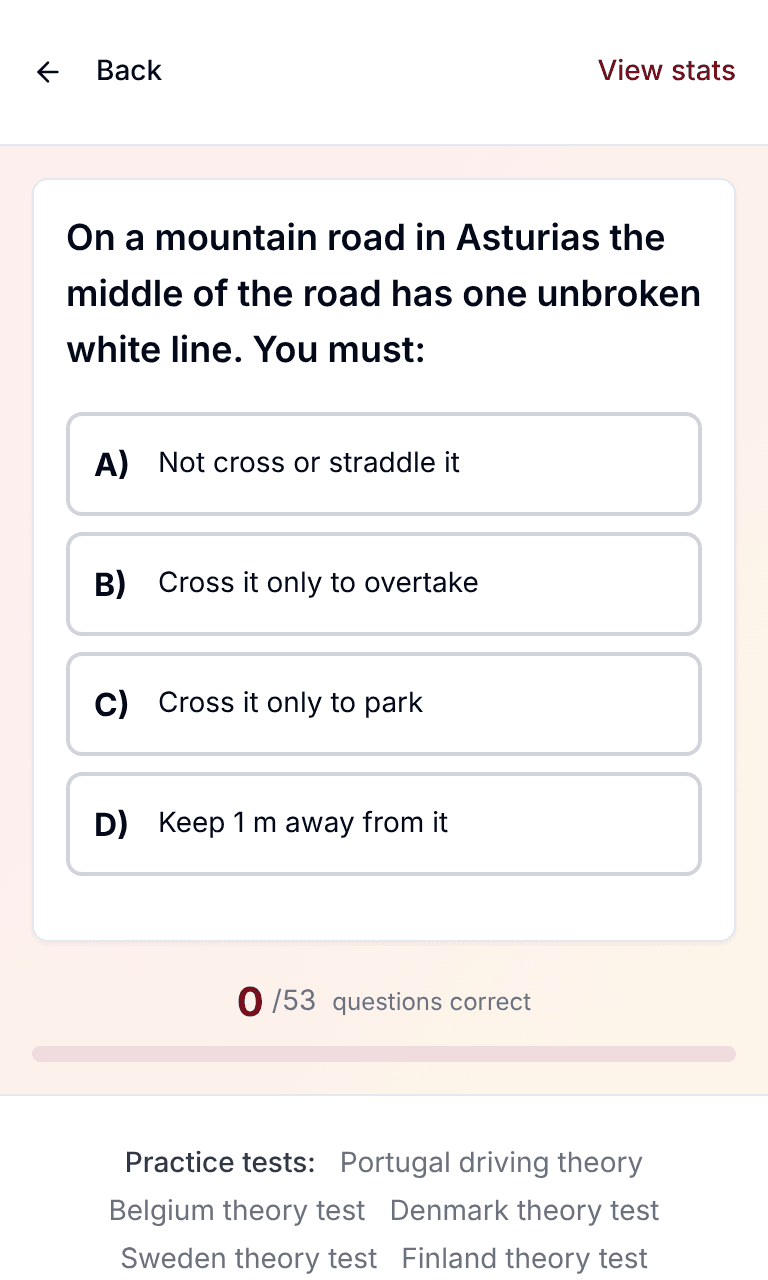
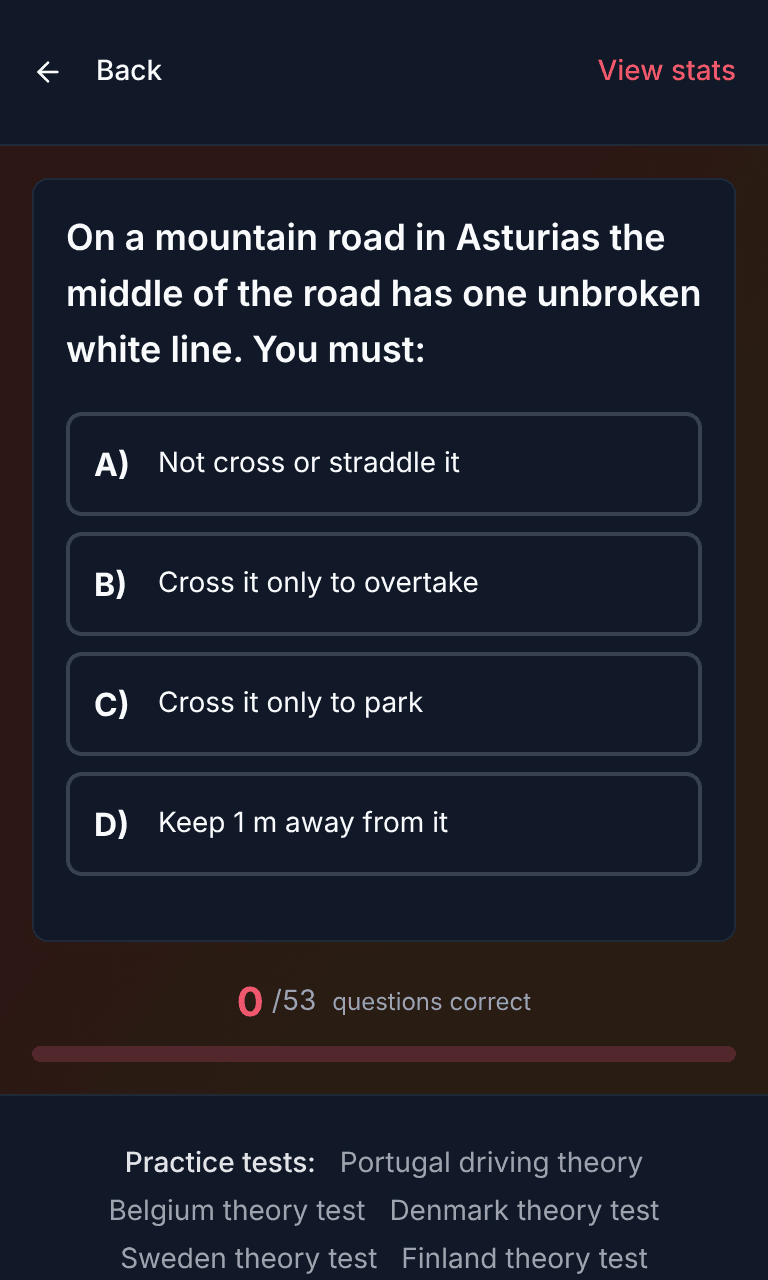
Train on mobile
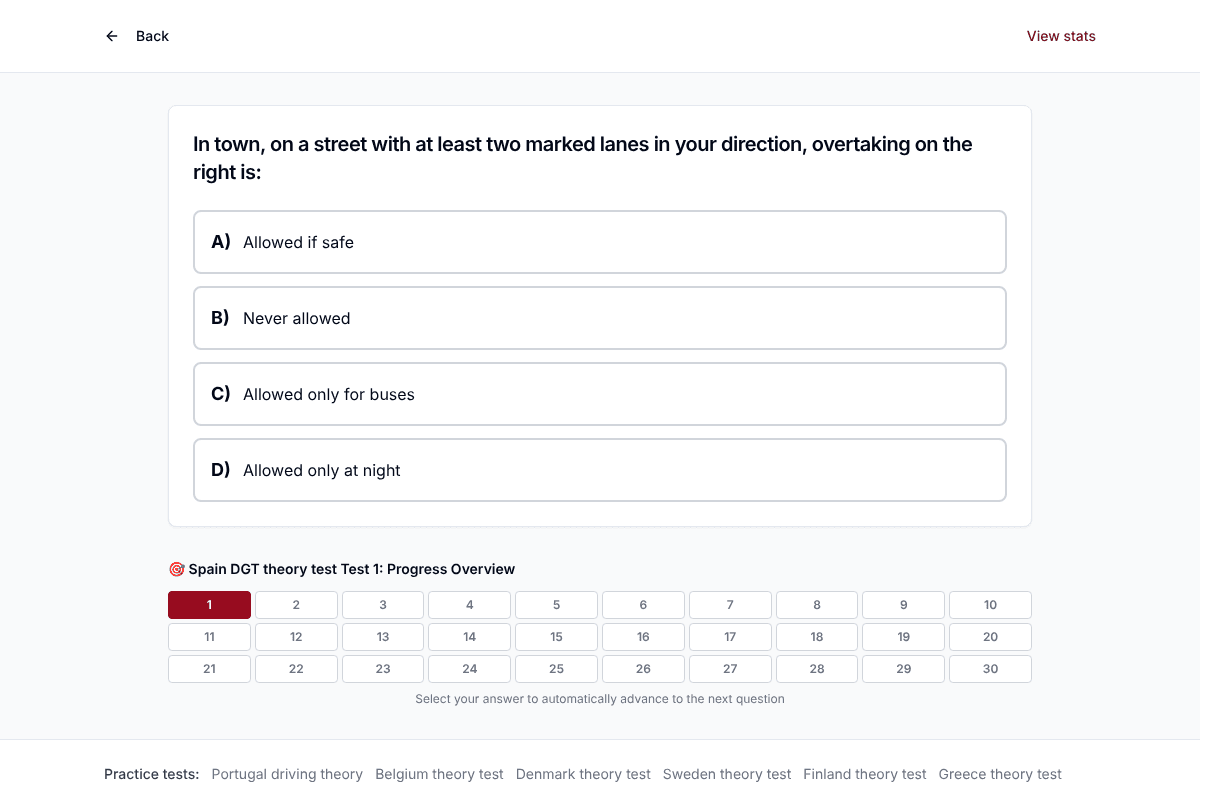
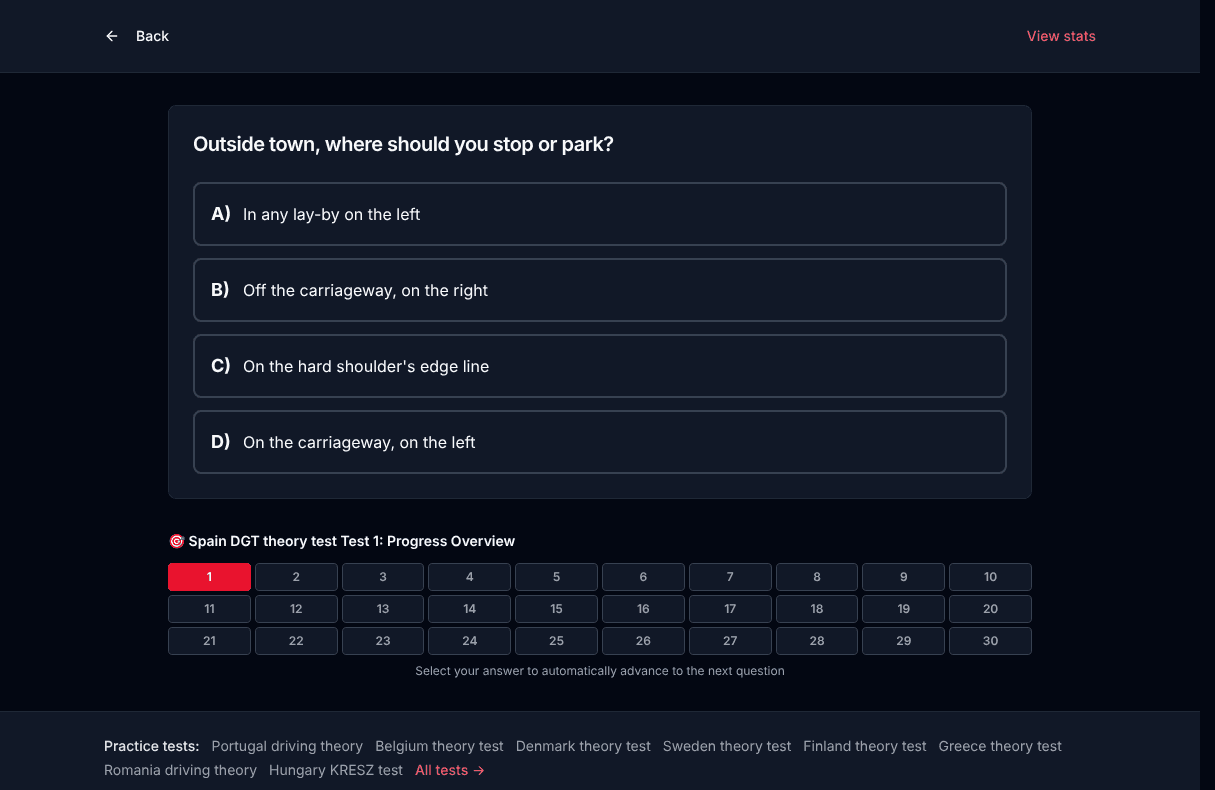
Test on desktop
The Spain DGT theory test exam at a glance
The DGT theory exam (examen teórico) is the first test for the Spanish car licence, the permiso B. It has 30 multiple-choice questions with three options each, you have 30 minutes, and you pass with no more than three mistakes, so 27 correct answers. For the permiso B it is offered in Spanish, the co-official languages (Catalan, Basque, Galician, Valencian), English, French and German, and in an Easy Read version. You can sit it from three months before you turn 18, the minimum age for the licence, and a pass is kept for two years while you take the practical driving test. Questions cover the Reglamento General de Circulación: signs, priority, speed limits, overtaking, parking, lights, alcohol, safety equipment and what to do after a crash.
Tigertest has 180 Spain DGT theory test practice questions with explanations, all free with no account required.
- Run by
- DGT (Dirección General de Tráfico), provincial traffic offices
- Questions
- 30, multiple choice, three options each
- Time
- 30 minutes
- Pass mark
- At most 3 mistakes (27 of 30)
- Languages
- Spanish, co-official languages, English, French, German
- Minimum age (permiso B)
- 18 (first exam up to three months before)
- Pass kept for
- Two years
- Tigertest mock tests
- 6 x 30 questions, 27 to pass
Updated by the Tigertest team. Practice questions follow Reglamento General de Circulación (consolidated with RD 518/2026, in force 1 October 2026), Reglamento General de Conductores and DGT guidance on the theory exam, checked November 2026. Exam rules change, so confirm current details with DGT: requirements, preparation and taking the exam.
How It Works
Train by Topic
Five training sets cover signs and markings, priority and junctions, speed and overtaking, parking and lights, and permits, alcohol and emergencies. Questions you miss come back until you have mastered them.
Full Mock Tests
Six 30-question tests like the real exam, 27 correct to pass, the DGT's three-mistake rule. No question repeats across tests, and every answer explains the rule and the common wrong pick.
Built on the Spanish Traffic Regulations
Every question is written from the Reglamento General de Circulación as in force in November 2026, including the changes of 1 October 2026: overtaking cyclists at least 20 km/h below the limit with 1.5 metres to spare, the emergency lane in motorway jams and the snow rules. Signs are described in words, in km/h and metres, for right-hand traffic. The DGT publishes no topic weights, so the split follows the syllabus, with signs and priority heaviest. The real exam has three options per question; ours have four.

Help Make Tigertest Better
Have an idea, a topic you'd like covered, or a question that could be clearer? We read every message and use it to improve every test.
Share FeedbackHow to Pass the DGT Theory Exam
1. Learn the speed limits as a table
Many mistakes come from numbers. For a car: 120 km/h on autopistas and autovías, 90 on conventional roads, 50 in a travesía, and in town 20, 30 or 50 km/h depending on whether the street is a single platform, has one lane each way or two or more. Add 60 km/h as the motorway minimum and 80 and 90 with a trailer.
2. Know who goes first
With no signs, give way to the right, but vehicles on a roundabout, on rails, on a paved road or already on the motorway come first. Officers' signals beat temporary signs, which beat traffic lights, then permanent signs, then road markings. Learn the officers' arm signals too.
3. Catch up with the 2026 changes
Since 1 January 2026 the connected V-16 beacon is the only valid way to signal a breakdown. Since 1 October 2026 you overtake cyclists outside towns at least 20 km/h below the limit, form an emergency lane in motorway jams and keep right without overtaking in snow. Questions on older rules, such as warning triangles, are out of date.
4. Aim for two mistakes or fewer
The real exam allows three mistakes in 30 questions, so leave a margin. Tigertest tracks your accuracy by topic: drill the questions you missed, retrain the weakest set, then take the six tests until you pass each with 28 or more.
DGT Theory Exam Frequently Asked Questions
Can I take the Spanish DGT theory exam in English?
Yes. For the permiso B, the DGT offers the theory exam in Spanish, in the co-official languages of the region where you sit it (Catalan, Basque, Galician or Valencian), and in English, French and German. You choose the language when you apply. An Easy Read (Lectura Fácil) version is also available for the A1, A2 and B licences.
How many questions are on the DGT theory exam and what is the pass mark?
The exam for the permiso B has 30 multiple-choice questions with three options each, and you have 30 minutes. You pass with no more than three mistakes, so you need 27 correct answers. A pass is kept for two years while you complete the practical test. As of November 2026 the DGT says the format is unchanged; risk-perception video questions are being studied but have no date.
What does the theory exam cover?
The syllabus in the Reglamento General de Conductores covers traffic law, especially signs, priority rules and speed limits, plus accident factors, attitudes to other road users, alcohol, drugs, fatigue and distraction, safe distances and road conditions, tunnels, vulnerable road users, vehicle documents, what to do after a crash, loads and passengers, leaving the vehicle, basic mechanics, safety equipment and eco-driving.
Which rule changes in 2026 should I know?
Since 1 January 2026, a connected V-16 beacon is the only valid way to signal a car stopped by a breakdown or crash; warning triangles no longer count. Since 1 October 2026, Real Decreto 518/2026 requires drivers to overtake cyclists outside towns at least 20 km/h below the limit with at least 1.5 metres of space, to change lane completely where there is more than one lane in their direction, to open an emergency lane in motorway jams, and to keep right without overtaking on snowy motorways.
Are these the real DGT questions?
No. Every question is original, written by Tigertest from the Reglamento General de Circulación, the Reglamento General de Conductores and the DGT's guidance, so it tests the same knowledge without copying any official question. Signs are described in words, so study pictures of Spanish signs too. Tigertest's questions have four options, one more than the real exam. It is free practice, not affiliated with the Dirección General de Tráfico (DGT), and it does not book or replace your exam.
Spain DGT theory test sample questions and answers
6 of the 180 practice questions, one from each topic, with the answer explained.
1. Which of these must use dipped headlights at all times, even in bright daylight?
- A.Cars towing a trailer
- B.Motorcycles
- C.Cars outside towns
- D.Vans on motorways
Answer: B. Motorcycles must always ride with dipped headlights, on every road and at any time of day. Cars need lights by day in tunnels and in reversible, additional or contraflow lanes.
2. On the AP-7 the red brake warning light stays on after you release the parking brake. You should:
- A.Carry on to the next town
- B.Pump the brake pedal hard
- C.Switch on the fog lights
- D.Stop safely and check the brakes
Answer: D. A red warning light signals a serious fault. With the parking brake off, the brake light can mean low brake fluid, so stop when it is safe and do not drive on until the brakes are checked.
3. Arrows painted in your lane point left and straight ahead. You may:
- A.Turn left or go straight
- B.Turn right only
- C.Turn right or go straight
- D.Make a U-turn
Answer: A. Lane arrows show the movements allowed from that lane. Here you may turn left or continue straight, but not turn right.
4. Elderly pedestrians are slowly crossing ahead on a marked crossing. You should:
- A.Drive round behind them
- B.Sound your horn
- C.Wait patiently for them
- D.Edge forward to hurry them
Answer: C. Pedestrians on a marked crossing have priority. Older people and children may need more time, so give it to them.
5. A traffic light is out of order and there are no other signs. At the junction you give way to:
- A.Traffic from your left
- B.The larger vehicle
- C.Traffic from your right
- D.Whoever sounds the horn
Answer: C. With no working signals, the general rule applies: give way to vehicles approaching from the right.
6. As a rule, people should get in and out of a car:
- A.On the side nearest the kerb
- B.On the driver's side only
- C.On either side
- D.On the side facing the traffic
Answer: A. Get in and out on the side nearest the edge of the road, and only when the car is stopped. Check for cyclists before you open a door.
Related practice tests
Every test on Tigertest is free and needs no account to start.
- Portugal Driving Theory Practice TestIMT (Instituto da Mobilidade e dos Transportes) · category B theory exam
- Belgium Driving Theory Practice TestApproved exam centres in Flanders, Wallonia and Brussels · category B theory exam
- Denmark Driving Theory Practice TestFærdselsstyrelsen (Denmark) · teoriprøve, category B
- Sweden Driving Theory Practice TestTrafikverket · knowledge test (kunskapsprov) B
- Finland Driving Theory Practice TestTraficom · theory test at Ajovarma (A-Katsastus)
- Greece Driving Theory Test PracticeMinistry of Infrastructure and Transport · Transport Directorate theory test
Ready to Pass Your DGT Theory Exam?
Free to start. No account required. 200 questions in English on the Spanish rules of the road.
Start practicing