
Free KS2 SATs Practice
Year 6 reading, grammar, punctuation and maths. A short lesson before every drill, then two practice tests with an estimated scaled score for each subject. Free, no account needed.
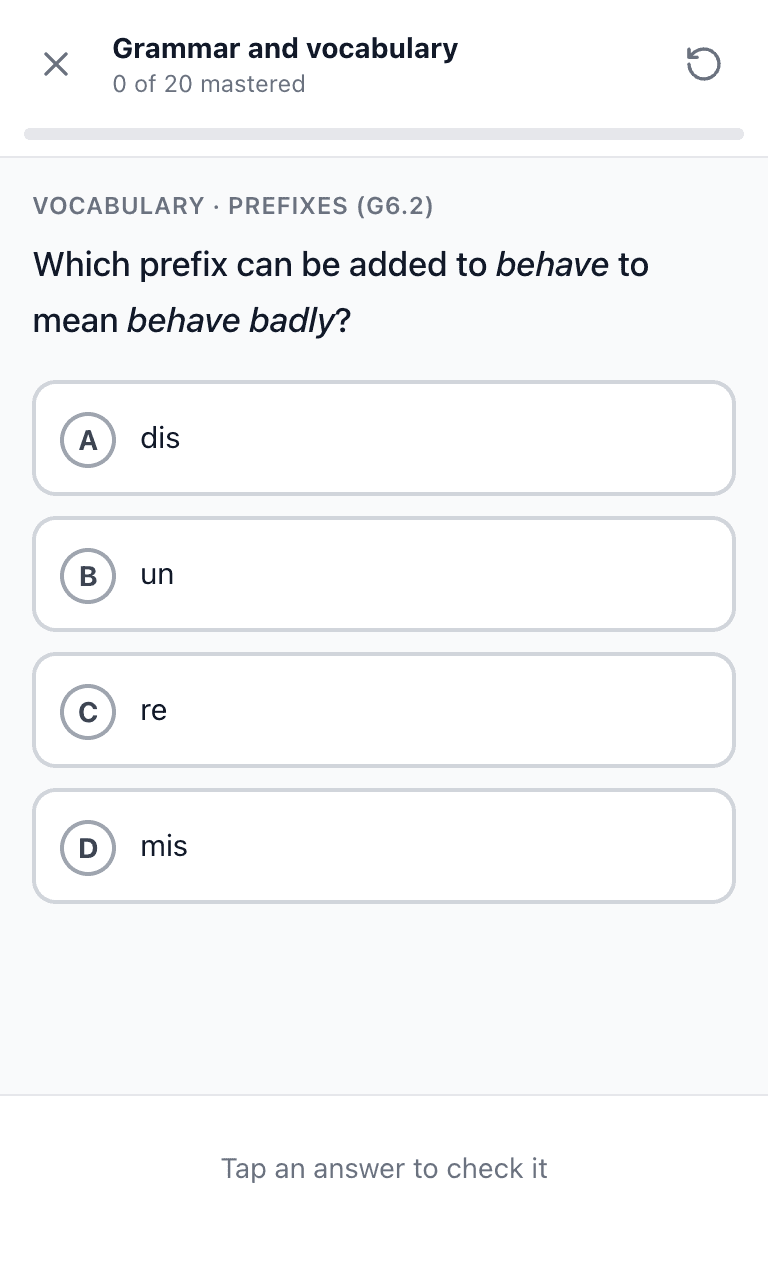
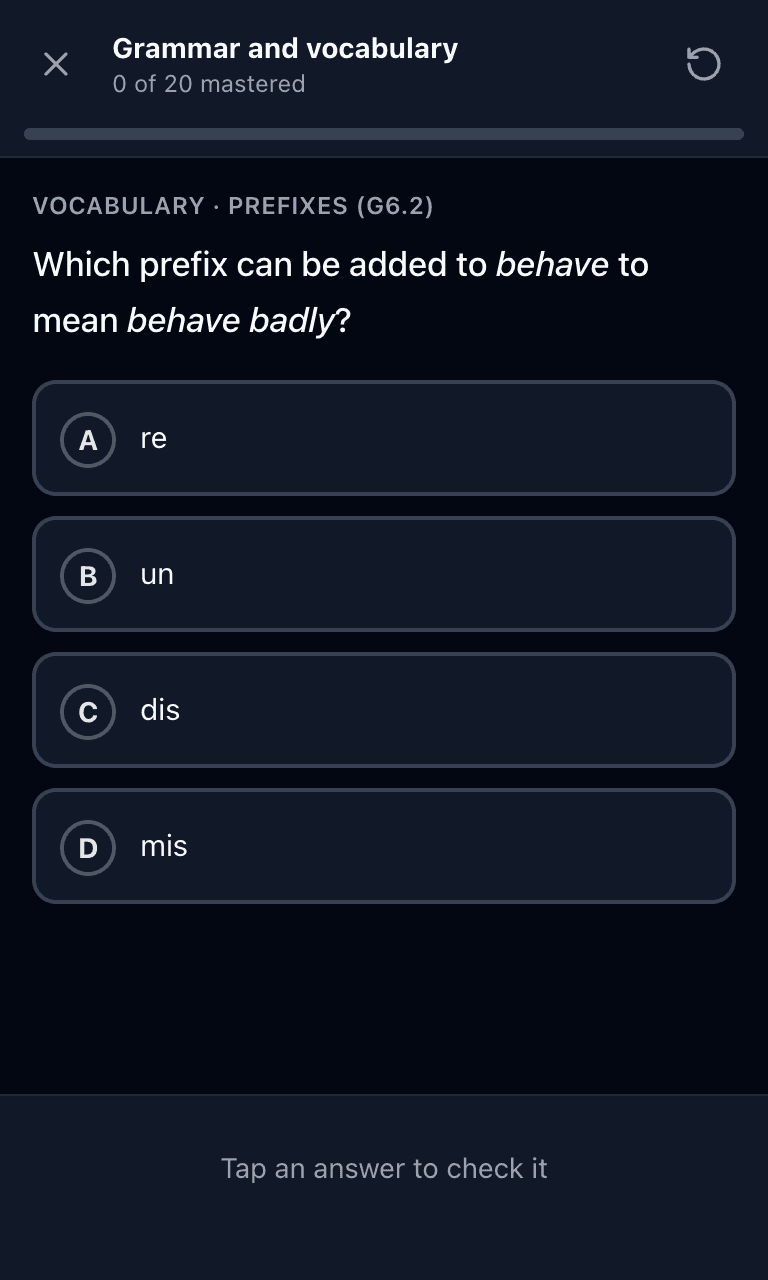
Train on mobile
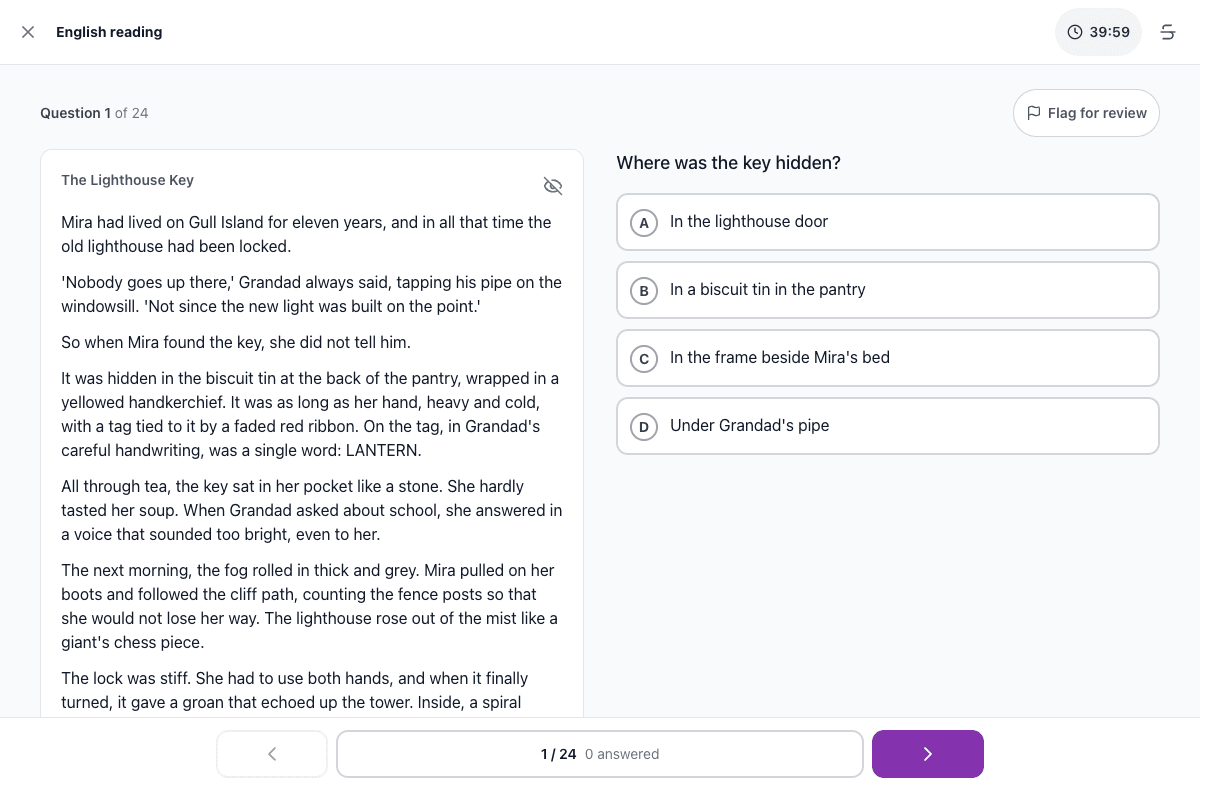
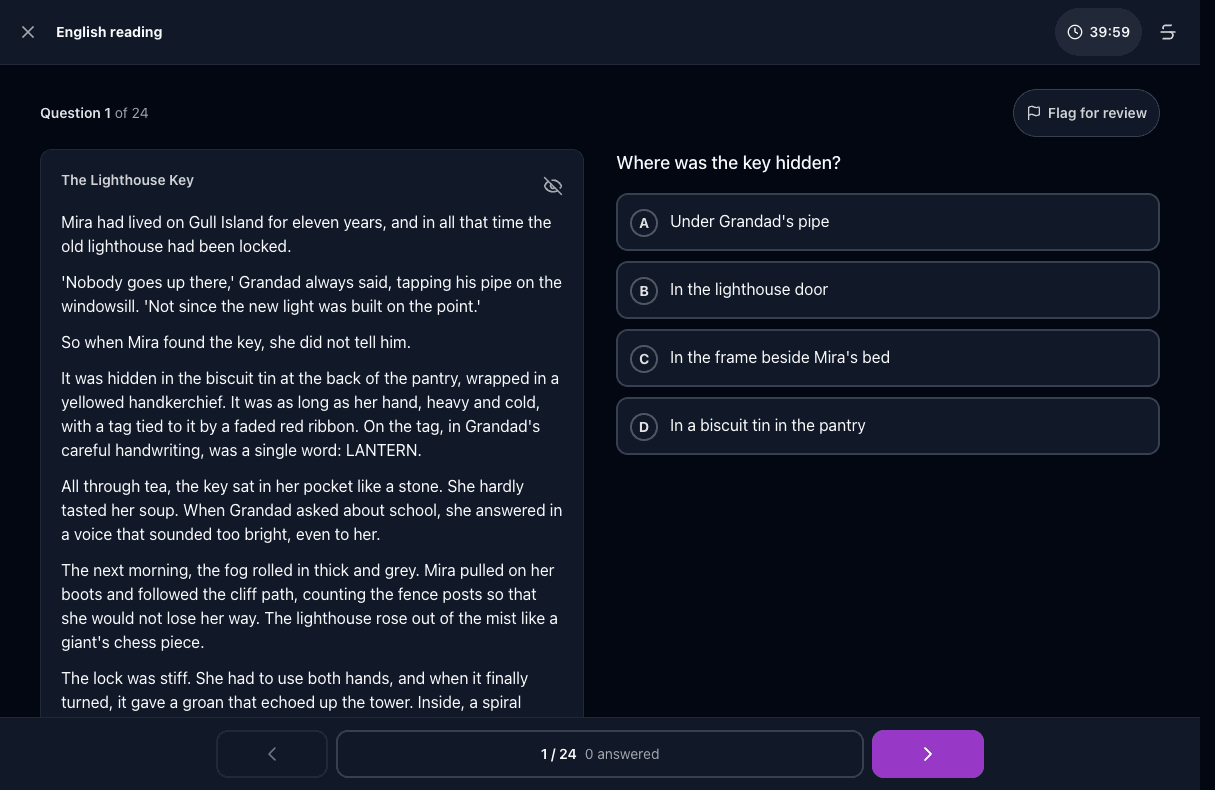
Test on desktop
The KS2 SATs exam at a glance
The KS2 SATs are the national curriculum tests every Year 6 pupil in England takes at school in May. English reading is one paper of three texts, 50 marks in 60 minutes. Grammar, punctuation and spelling is a 50-mark question paper in 45 minutes plus a 20-word spelling test. Mathematics is an arithmetic paper (40 marks, 30 minutes) and two reasoning papers (35 marks, 40 minutes each), with no calculator. Each subject is reported as a scaled score from 80 to 120, and 100 is the expected standard. Writing is assessed by the teacher, not by a test.
Tigertest has two KS2 SATs practice tests (reading, grammar and punctuation Paper 1, and maths Papers 1, 2 and 3, each about 60% of the real length) with an estimated scaled score per subject, and five drills that each start with short lessons. All of it is free with no account required; the spelling test is not modelled.
- Who takes it
- Year 6 pupils in England, in May
- Reading
- 1 paper, 3 texts, 50 marks, 60 minutes
- Grammar, punctuation and spelling
- Paper 1: 50 marks, 45 minutes; Paper 2: 20-word spelling test
- Maths
- Arithmetic 40 marks, 30 min; two reasoning papers, 35 marks, 40 min each; no calculator
- Scores
- Scaled 80 to 120 per subject; 100 is the expected standard, 110+ a high score
- Marks needed for 100 (2026)
- Reading 25/50, GPS 34/70, maths 56/110
- Given by
- The child's school, set by the Standards and Testing Agency
Updated by the Tigertest team. Practice questions follow the Standards and Testing Agency's key stage 2 test frameworks for English reading, English grammar, punctuation and spelling, and mathematics, and the 2026 scaled score conversion tables. Exam rules change, so confirm current details with Standards and Testing Agency: 2026 key stage 2 scaled score conversion tables.
How It Works
Lessons, Then Drills
Five drills: reading, grammar and vocabulary, punctuation, arithmetic and reasoning. Each starts with short lessons your child taps through, like fronted adverbials or long multiplication, then 20 questions from easy to hard. Every miss comes back until it is learned.
Two Practice Tests
Each test has the same papers as the real SATs, timed and in the same order, at about 60% of the length. Results show an estimated scaled score for reading, grammar and maths, where 100 is the expected standard. Practice Test 2 never appears in the drills.
The Same Papers as the Real SATs
Topics and weightings follow the Standards and Testing Agency's key stage 2 test frameworks. No calculator, just like the real thing.

Teach a Year 6 Class?
Set SATs practice as homework for free: share one link, children join with just their first name, and you see who practised, their estimated scaled scores and the skills your class finds hardest.
Make a class at tigertest.io/teachHow to Prepare for the KS2 SATs
1. Know the words in the questions
Grammar questions use the terms children learn at school: relative clause, fronted adverbial, subordinate clause, determiner, passive. A child who knows the words can answer the question; the lessons before the grammar and punctuation drills teach them one at a time.
2. Find the evidence in reading
Most reading marks come from finding information and making inferences. For every answer, a child should be able to point to the words in the text that prove it. That habit is what the reading lessons practise.
3. Get written methods secure for arithmetic
The arithmetic paper is quick marks for a child who can do column addition and subtraction, short division, long multiplication and fractions without slips. Practise the method until it is automatic, then check answers with the inverse.
4. Little and often
Fifteen minutes a few times a week beats a long session the weekend before. A drill is 20 questions and the missed ones come back, so each session ends on the questions that need it most.
KS2 SATs Questions
What are the KS2 SATs?
They are the national curriculum tests every Year 6 pupil in England takes at school in May. There are three subjects: English reading (one paper, 60 minutes), English grammar, punctuation and spelling (a 45-minute question paper and a short spelling test) and mathematics (an arithmetic paper of 30 minutes and two reasoning papers of 40 minutes each). Calculators are not allowed. Writing is assessed by the teacher instead of a test.
What is a scaled score, and what is the expected standard?
Each subject's raw mark is turned into a scaled score from 80 to 120. A scaled score of 100 or more means a child has met the expected standard, and 110 or more is reported as a high score. The number of marks needed for 100 changes a little each year; in 2026 it was 25 out of 50 in reading, 34 out of 70 in grammar, punctuation and spelling, and 56 out of 110 in maths.
How close are these practice tests to the real SATs?
They follow the same papers, question types and topic weightings as the official test frameworks, but each practice test is about 60% of the real length, with the time cut in proportion: 24 reading questions on three texts in 40 minutes, 30 grammar and punctuation questions in 27 minutes, and 44 maths questions across an arithmetic paper and two reasoning papers. The scaled score shown is our estimate, not an official result. The spelling test, which the teacher reads aloud, is not included.
What are the lessons before each drill?
Short click-through lessons on one skill at a time: finding answers in a text, inference, words in context, word classes, relative clauses, active and passive, the subjunctive, fronted adverbials, apostrophes, inverted commas, brackets, BODMAS, long multiplication, short division, adding fractions, percentages, fractions of amounts, ratio, angles and time. Each lesson asks the child to supply every step, then checks it with two quick questions. A missed drill question offers the matching lesson again.
When should my child start practising?
Most Year 6 classes revise for the SATs from January to May. Short, regular practice works best: one drill of 20 questions takes about 15 minutes. Start with the drills, which teach the basics first, and save the practice tests for later, ideally Practice Test 1 a few months before the SATs and Practice Test 2 in the last few weeks.
Is it free?
Yes, all of it: every lesson, drill and both practice tests, with no account needed. An account saves progress across devices, so a child can practise on a laptop at home and a tablet at a grandparent's.
I teach a Year 6 class. Can my students use Tigertest?
Yes, for free. Make a class at tigertest.io/teach, post one link, and students join with just their name. You see who practiced, their test scores and the topics your class misses most.
Related practice tests
Every test on Tigertest is free and needs no account to start.
- Times Tables Practice TestPrimary school · Year 2 to Year 4 MTC
- 11+ Practice TestGrammar school entry · English, maths, verbal reasoning
- GCSE Maths Foundation Practice TestFoundation tier · AQA, Pearson Edexcel and OCR
- GCSE Maths Higher Practice TestAQA, Edexcel and OCR (England)
- GCSE Combined Science Practice TestGCSE double award · Biology, Chemistry, Physics
- GCSE Computer Science Practice TestAQA, OCR and Pearson Edexcel (England)